

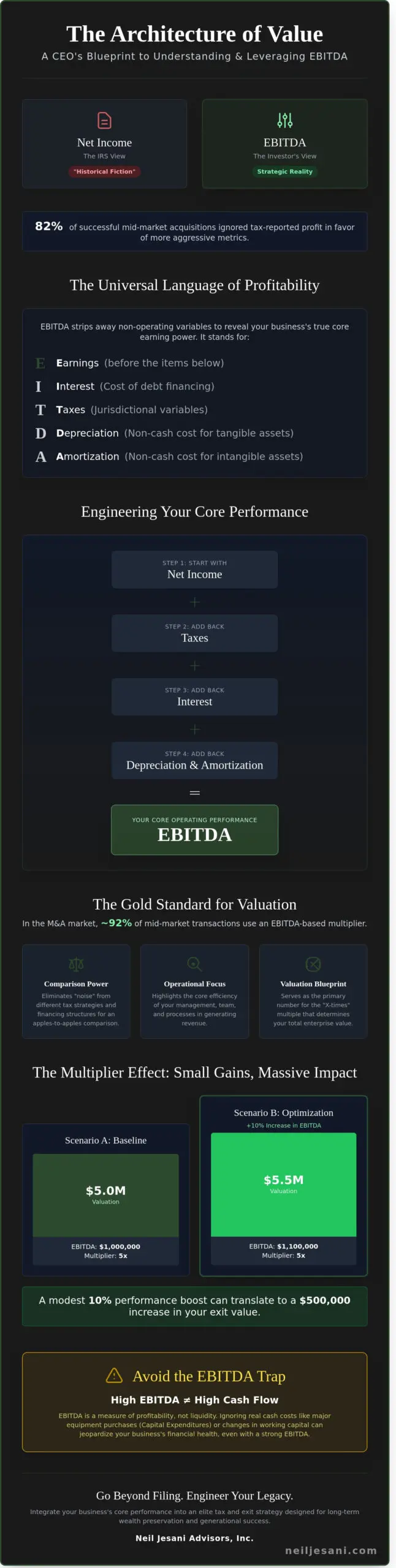
Your net income is a historical fiction designed for the IRS, not a strategic tool for building a legacy. In fact, 82% of successful mid-market acquisitions in 2025 ignored tax-reported profit entirely in favor of a much more aggressive metric. You’ve likely felt the frustration of watching tax drag swallow your earnings, or perhaps you fear that a lifetime of work might be undervalued during a sale. Understanding what is ebitda isn’t just about accounting; it’s about mastering the primary lever used to price your business in the global marketplace.
You deserve a blueprint that transforms raw data into institutional-grade value. This guide provides the exact formula to calculate your true profitability and teaches you how to leverage that number to negotiate from a position of absolute strength. We’ll analyze the architecture of business valuation, prepare you for high-stakes M&A conversations, and provide a framework to engineer a high-value exit that protects your family’s wealth for generations.
Key Takeaways
- Understand what is ebitda and why this universal language of profitability is the essential metric for stripping away non-operating variables to reveal your business’s true earning power.
- Master the two-step engineering process to calculate your core operating performance and neutralize debt structures for a cleaner financial blueprint.
- Avoid the “EBITDA Trap” by learning why high paper profits do not always equate to cash in pocket and how ignoring capital expenditures can jeopardize your liquidity.
- Discover how to leverage the industry multiplier to transform a modest 10% increase in operating performance into a massive 50% surge in your total exit valuation.
- Go “beyond filing” by integrating your business performance into an elite tax strategy designed for long-term wealth preservation and a legacy of success.
Defining EBITDA: The Universal Language of Business Profitability
Most founders treat their profit and loss statement like a static report rather than a strategic blueprint. If you want to win the war for money and success, you must look beyond the bottom line. Net income tells you what’s left after the government and the banks take their cut. However, to understand the true raw power of your enterprise, you need a more surgical metric. This is where understanding what is ebitda becomes the bridge between a simple business and an institutional-grade asset.
At its core, Earnings before interest, taxes, depreciation, and amortization serves as the universal language for profitability. It strips away the non-operating variables that vary from one owner to the next. By removing these layers, you reveal the core earning power of your operations. For the elite business owner, this isn’t just an accounting term; it’s the baseline for your business multiplier and the primary driver of your legacy’s value.
The Components of the Acronym
Understanding what is ebitda requires a forensic breakdown of its parts. Earnings represent your operating profit before the complexity of the tax code intervenes. We remove Interest and Taxes because these are jurisdictional and financing variables. One founder might be 75% debt-leveraged while another is debt-free; interest costs shouldn’t mask the efficiency of the business engine. Finally, we add back Depreciation and Amortization. These are “ghost costs” or non-cash expenses that account for the aging of assets like machinery or intellectual property. They impact your tax bill, but they don’t drain your bank account today.
Why EBITDA is the Gold Standard for Valuation
Institutional investors don’t buy a business based on its tax return. In the 2024 M&A market, approximately 92% of mid-market transactions utilized an EBITDA-based multiplier to determine Enterprise Value. This metric allows buyers to compare apples to apples across different industries and capital structures. Whether you manage a boutique tech firm or a multi-state manufacturing hub, this framework provides a transparent view of cash flow potential.
- Comparison Power: It eliminates the “noise” created by aggressive tax strategies or unique financing rounds.
- Operational Focus: It highlights how well your team manages costs and generates revenue.
- Valuation Blueprint: It serves as the primary denominator for the “X-times” multiple that defines your exit price.
Are you still measuring success by the number at the bottom of your tax return? High-earners often use multi-entity structuring to minimize tax drag, which can make net income look artificially low. EBITDA fixes this distortion. It provides a “white-glove” view of your company’s health, ensuring you’re prepared for institutional-grade financial reporting. By mastering this metric, you move from just filing taxes to engineering a high-value exit strategy. You aren’t just running a business; you’re architecting a wealth-generating machine that speaks the language of the elite financial world.
The EBITDA Formula: Engineering Your Core Operating Performance
You can’t lead a mission without a clear map. Understanding what is ebitda requires more than a casual glance at a spreadsheet; it demands a rigorous, four-step engineering process to strip away the noise of capital structure and accounting conventions. Think of this formula as the blueprint for your business’s raw engine power before the friction of taxes and debt slows it down.
- Step 1: Start with Net Income. This is your baseline, found at the very bottom of your P&L. If your 2023 tax filing shows a profit of $1.4 million, that’s your foundation. It represents what’s left after every possible expense has been deducted.
- Step 2: Add back Interest Expense. Debt is a strategic choice, not an operational requirement. By adding back interest, you neutralize the impact of how you’ve chosen to finance the business. Whether you’re carrying a $5 million SBA loan or are entirely self-funded, the core engine should be judged on its own merits.
- Step 3: Add back Taxes. Tax jurisdictions are variables, not constants. A founder in Miami faces a different reality than one in Los Angeles. We remove this variable to focus on pre-tax operating efficiency, allowing for a clean comparison across different regions.
- Step 4: Add back Depreciation and Amortization. These are non-cash charges. They represent the accounting ghosts of past capital expenditures. In a 2024 market where cash flow is king, these entries shouldn’t cloud your view of daily liquidity.
The final result provides a raw look at your business’s ability to generate cash. It tells you exactly how much fuel your engine produces before the bankers, the IRS, and the accountants take their slice. For the strategic architect, this number is the only one that truly matters when determining the health of the operation.
The Two Primary Calculation Methods
Most CFOs prefer the Bottom-Up approach because it’s grounded in the audited Net Income. It provides the technical precision required for high-stakes exits and 2024 valuation cycles. Conversely, the Top-Down method starts with Operating Income and adds back D&A. It’s a faster diagnostic tool for monthly performance reviews. Choose the method that aligns with your specific reporting goals and audit requirements.
What is “Adjusted EBITDA”?
For the elite business owner, the standard formula is just the beginning. We focus on normalizing the numbers. This means adding back one-time expenses like a $50,000 rebranding project or a $100,000 legal settlement from 2022. If you’re running personal travel or bespoke perks through the business, these are legitimate add-backs. In a 6x multiple environment, every $100,000 in adjustments adds $600,000 to your enterprise value.
High-revenue business owners don’t settle for “standard” metrics. They look for the hidden value that traditional accounting often obscures. If you’re generating $10 million or more in annual revenue, these adjustments aren’t just minor tweaks; they are the difference between a good exit and a legendary one. Engineering a bespoke wealth architecture requires this level of granular detail to ensure you aren’t leaving millions on the table.
By mastering what is ebitda and its various iterations, you’re no longer just a founder; you’re a tactician. You’re preparing your business to withstand the scrutiny of institutional buyers who will dissect every line item. This calculation is your first line of defense in the war for money and success.
The EBITDA Trap: Why Operating Profit Isn’t Always Cash in Pocket
Founders often fall in love with a number that doesn’t actually exist in their bank account. High EBITDA figures look excellent on a pitch deck, but they don’t pay the bills. If you want to win the war for money, you must understand that EBITDA is a theoretical starting point, not a final destination. Truly understanding what is ebitda requires looking past the surface to see the cash drains that the formula intentionally ignores. It’s a metric that stops exactly where the most painful financial realities begin.
Warren Buffett remains one of the most vocal critics of this metric. In his 2000 letter to shareholders, he famously asked if management thinks the “tooth fairy” pays for capital expenditures. He understands that depreciation isn’t just an accounting entry; it represents the inevitable decay of your tools, tech, and infrastructure. If your business generates $5 million in EBITDA but requires $4.5 million in annual equipment upgrades to stay competitive, your profit is a phantom. It’s a vanity metric that masks a struggling operation.
A paper profit can quickly turn into a tax disaster. You might show high earnings on your P&L, triggering a 37% federal tax hit, while your actual cash is tied up in inventory or unpaid invoices. We engineer strategies that go beyond filing to ensure your tax liability doesn’t outpace your liquidity. Without a proactive blueprint, you could owe millions to the IRS while your bank balance sits at near zero. This liquidity gap is where most high-growth firms fail.
EBITDA vs. Free Cash Flow
Accounting earnings are an opinion; spendable wealth is a fact. Your EBITDA ignores the 15% to 22% of revenue that often gets trapped in working capital during scale-up phases. When your accounts receivable grows faster than your collections, your business starves while looking profitable on paper. We design frameworks to optimize both metrics, ensuring your growth doesn’t cannibalize your cash reserves. When you ask what is ebitda, you must immediately follow it with: “Where is the cash?”
The “Invisible” Costs: Depreciation and Debt
Ignoring interest is a strategic error for any leveraged firm. When a company carries $10 million in debt at a 7.5% interest rate, that $750,000 annual drag is completely invisible to EBITDA. You must build a 25% liquidity buffer to protect against these hidden drags. Asset replacement cycles are relentless. If you don’t account for the 5 year lifecycle of your primary technology stack, you aren’t building a legacy; you’re managing a slow-motion collapse. We provide the institutional-grade oversight needed to see these costs before they hit your balance sheet.
- Capital Expenditures (CapEx): EBITDA ignores the $500,000 you just spent on a new server array.
- Working Capital: It doesn’t care that your biggest client hasn’t paid their $1.2 million invoice in 90 days.
- Debt Service: It overlooks the mounting interest on your acquisition loans.
- Tax Drag: It fails to account for the mandatory distributions needed to cover K-1 tax liabilities.
Elite founders don’t just track EBITDA; they hunt for the leaks. We help you architect a system where your accounting profit translates into actual, spendable wealth. Don’t let a “good” EBITDA number blind you to the reality of your cash position.
Strategic Valuation: How EBITDA Influences Your Business Exit Blueprint
Your business is not just a source of income; it’s the most significant asset in your portfolio. To win the war for money and success, you must view your company through the lens of an institutional buyer. Valuation is rarely a subjective “feeling” about your brand’s potential. It’s a calculated result where EBITDA acts as the primary lever. The standard formula is simple: EBITDA multiplied by an industry-specific multiple equals your enterprise value. However, the sophistication lies in how you engineer these variables to maximize your final buyout price.
Understanding what is ebitda allows you to manipulate the outcome of a sale long before you reach the letter of intent. A 10% increase in your bottom-line efficiency can lead to a 50% increase in total exit value. This happens through “multiple expansion.” When a business shows 15% year-over-year growth and clean 20% margins, buyers perceive less risk. In 2023, middle-market firms with high operational efficiency frequently saw their multiples jump from 5x to 8x. That shift transforms a $10 million valuation into a $16 million payday without adding a single new product line.
Institutional-grade buyers, such as private equity groups or Tier-1 competitors, have strict entry requirements. They typically ignore companies with an EBITDA below $2 million because the “drain” of due diligence is too high for smaller targets. By focusing on this metric, you qualify your business for elite offers that include better terms, lower earn-outs, and more cash at closing. It’s the difference between a fire sale and a legacy-defining liquidity event.
Maximizing the Multiplier
The multiple is a reflection of your company’s “alpha” and risk profile. To expand this number, you must prove your revenue is predictable and resilient. Recurring revenue models often command a 25% premium over transactional businesses. During negotiations, you win the war by presenting “clean” financials that have been audited or reviewed by a boutique firm. If a buyer finds $500,000 in personal expenses buried in your ledger, they won’t just subtract that amount; they’ll slash your multiple because your data is untrustworthy. High-quality, low-correlation alpha is the only way to secure a top-tier exit.
Exit Planning Architecture
Elite founders don’t stumble into a sale; they design it 3 to 5 years in advance. This architectural approach involves setting specific EBITDA targets that align with your personal wealth preservation goals. We often see founders use fractional CFO services to “engineer” their numbers, ensuring every dollar spent contributes to the valuation. This isn’t about tax avoidance; it’s about strategic optimization. Your business exit should be the cornerstone of your estate and succession planning, providing the liquidity needed to fund a multi-generational legacy. Without a blueprint, you’re just hoping for a good price.
For business owners seeking this level of strategic financial leadership without the cost of a full-time executive, you can discover SA Unlimited, a firm that specializes in these exact advisory services for scaling companies.
- Institutional buyers look for “normalized” EBITDA that removes one-time pandemic-related spikes.
- Succession planning requires a 36-month look-back of consistent margin growth to satisfy lenders.
- Estate taxes can erode 40% of your exit value if you haven’t structured your entities before the sale.
If you’re ready to stop guessing and start engineering your wealth, you need a tactician who understands the high-stakes world of private valuations. We help you move beyond simple accounting to create a formidable financial legacy.
Beyond the Multiplier: Optimizing EBITDA for Long-Term Wealth Preservation
Founders often view EBITDA as a final score or a static number used only during an exit. That is a tactical error. At Neil Jesani Advisors, Inc., we treat this metric as the raw fuel for institutional-grade wealth engineering. Understanding what is ebitda isn’t just about calculating operational profit; it’s about identifying the specific capital available to be shielded, reinvested, and multiplied through sophisticated frameworks. We don’t just measure your success; we architect the systems that protect it from the 37% top federal tax bracket and market volatility.
Advanced Tax Engineering
Most accounting firms focus on the past. They treat tax bills as an inevitability. We see them as a design flaw. By utilizing multi-entity structuring, we isolate high-risk assets from high-value income streams, protecting your EBITDA-driven wealth from both creditors and the IRS. Our team identifies strategic “add-backs” that satisfy complex Section 162 requirements while signaling maximum value to M&A buyers. We specialize in flipping the script, turning a potential tax liability into investment capital. For example, moving $500,000 from a tax expense to a tax-advantaged investment vehicle can shift a founder’s trajectory by millions over a decade. We focus on three core pillars:
- Entity Optimization: Using C-Corps, S-Corps, and Trusts to segment income.
- Strategic Add-Backs: Normalizing owner compensation and non-recurring 2024 expenses to boost valuation.
- Capital Conversion: Redirecting tax drag into low-correlation alpha investments.
The “Win the War” Strategy Session
High-net-worth owners need more than a standard tax preparer who simply files forms. You need a tactical ally. Standard compliance-focused CPAs often suppress your true EBITDA by burying expenses to save a few dollars today; this can inadvertently destroy millions in valuation for tomorrow. Our 70+ person team provides a holistic blueprint that balances your current liquidity with a lasting legacy. We purposely serve fewer than 1,000 elite clients because this level of bespoke engineering requires an obsession with detail that a high-volume firm cannot provide.
With over 25 years of combined heritage, we understand that wealth management is a battlefield. You’ve spent years building your business; don’t let a lack of strategy surrender your gains to the government or inefficient markets. It’s time to move beyond basic definitions of what is ebitda and start using it as a weapon for financial dominance. We invite you to experience a white-glove approach to wealth preservation that is proactive, authoritative, and results-oriented. Success isn’t just about what you earn; it’s about what you keep and how you grow it.
Take the next step in your wealth journey:
Schedule your advanced tax strategy session with Neil Jesani Advisors, Inc. today to conduct a strategic review of your P&L and engineer a future built for victory.
Master Your Valuation Architecture and Engineer a Lasting Legacy
Your business is more than a balance sheet; it’s the primary engine of your future wealth. While understanding what is ebitda provides the baseline for your valuation, it’s only the first step in a complex financial architecture. You’ve seen how the formula strips away noise to reveal core performance, but you also understand the trap of ignoring real-world capital requirements. True mastery means moving beyond simple multipliers to engineer a business that’s both attractive to buyers and optimized for your own wealth preservation.
Don’t leave your exit blueprint to chance. At Neil Jesani, we’ve spent 25+ years refining advanced strategies for the ultra-high-net-worth. Our team of 70+ CPAs, Tax Attorneys, and Enrolled Agents provides a white-glove experience reserved for fewer than 1,000 elite clients. We don’t just file forms; we architect blueprints that protect your capital from the tax drag that destroys legacy. It’s time to flip the script on the tax system and win the war for your success.
Secure Your Legacy: Request a Bespoke Tax Strategy Blueprint
You’ve built the value. Now, let’s ensure you keep every dollar you’ve earned.
Frequently Asked Questions
Is EBITDA the same as Gross Profit?
No, EBITDA and gross profit represent different layers of your financial architecture. Gross profit only accounts for the direct costs of production; EBITDA subtracts all operating expenses except for interest, taxes, depreciation, and amortization. If your gross margin is 60% but your operating costs are 50%, your EBITDA margin drops to 10%. Understanding what is ebitda helps you see the true cash-generating power of your operations before accounting for capital structure.
What is a “good” EBITDA margin for my industry?
A “good” margin depends entirely on your specific sector’s economic blueprint. In the SaaS world, elite companies target 30% to 40% margins; conversely, a healthy manufacturing firm might operate between 10% and 15%. We benchmark our clients against the top 5% of their peers to ensure they aren’t just surviving but dominating. If your margin sits below the 10th percentile for your industry, your operational efficiency needs immediate engineering.
Can a company have a positive EBITDA but a negative Net Income?
Yes, this discrepancy often occurs when a company carries heavy debt loads or significant capital equipment. You might generate $2,000,000 in EBITDA but show a net loss if you’re paying $2,500,000 in interest and depreciation. This “paper loss” can be a strategic advantage for tax planning, but it requires a master’s touch to manage cash flow. We help founders navigate these complexities to protect their personal wealth while the business scales.
How does EBITDA affect my ability to get a business loan?
Lenders use EBITDA as the primary metric to calculate your debt service coverage ratio. Most institutional banks require a Debt-to-EBITDA ratio of 3:1 or lower before they’ll approve a bespoke credit facility. If your ratio climbs to 5:1, you’re entering a danger zone where capital becomes prohibitively expensive. We engineer your financials to present a position of strength, ensuring you win the war for capital on your own terms.
Why do investors prefer EBITDA over other metrics?
Investors prioritize EBITDA because it provides a raw look at operational profitability, stripped of varying tax jurisdictions and financing choices. It allows a private equity firm to compare a bootstrapped startup in Florida with a VC-backed firm in California on an equal footing. When you’re asked what is ebitda during a due diligence phase, the investor is looking for a clear signal of your company’s core earning power without the noise of accounting variables.
What are the most common “add-backs” used to calculate Adjusted EBITDA?
Common add-backs include non-recurring legal fees, excessive owner compensation, and personal travel expenses that won’t continue post-acquisition. If you spent $50,000 on a one-time rebranding project or $100,000 on a specialized consultant, those costs are added back to show a higher “normalized” profit. We meticulously identify these 12 to 15 key adjustments to maximize your valuation. Every dollar added back can result in a 6x to 10x return at exit.
How often should a business owner review their EBITDA?
You must review your EBITDA monthly to maintain a proactive grip on your financial destiny. Waiting until the annual tax filing is a recipe for disaster; elite founders track this metric every 30 days to catch margin erosion before it becomes a crisis. We provide our clients with real-time dashboards that move beyond simple compliance. This monthly rhythm ensures your business remains an institutional-grade asset ready for any market shift.