
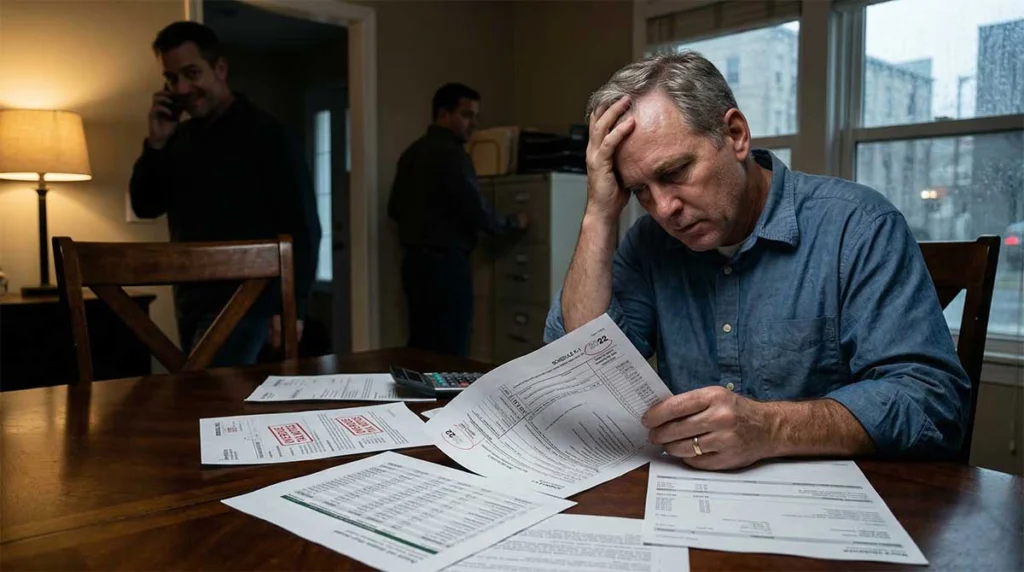
One Missed Form. One Missed Deadline. A $1.5 Million Estate Tax Bill That Didn’t Have to Happen.
Imagine this: Your spouse passes away. The estate is well under the federal exemption threshold. No estate tax is owed. Your attorney and accountant both agree—there is nothing left to do. You grieve. You settle the estate. You move on.
Years later, you die. Your estate is larger now. Your children hire an estate attorney and a tax advisor to file the necessary returns. That’s when they discover something devastating: a critical IRS election was never made after your spouse died. Because no one filed a single form—a form that wasn’t technically required—your family now owes over $1.5 million in federal estate taxes that could have been entirely avoided.
This isn’t a hypothetical. It happened. And in July 2025, the U.S. Tax Court confirmed that there was nothing anyone could do about it.
At Neil Jesani Advisors, Inc., we work with high-net-worth individuals, families, and business owners across the country to ensure that moments like this never happen. Understanding the portability election, Form 706, and the stakes involved is one of the most important pieces of estate planning that most families never think about—until it’s too late.
The $1.5 Million Mistake: Estate of Rowland v. Commissioner
In Estate of Billy S. Rowland, T.C. Memo. 2025-76, the U.S. Tax Court handed down a ruling that sent shockwaves through the estate planning community. The facts were not unusual. In fact, they describe circumstances familiar to millions of American married couples.
Fay Rowland died on April 8, 2016. Her estate was valued at approximately $3 million—comfortably below the 2016 filing threshold of $5.45 million. No estate tax was owed. Her executor, however, recognized that Fay had unused exemption that her surviving husband, Billy, might someday need. The executor filed a Form 706 estate tax return, citing the portability election under Rev. Proc. 2017-34.
There was just one problem.
The return wasn’t “complete and properly prepared” in the way the IRS and Treasury regulations require. Asset schedules were filled out using placeholder language rather than actual fair market valuations. The filing also arrived after the applicable deadline under the extended safe harbor. When Billy died in January 2018 with a taxable estate, his estate sought to use Fay’s deceased spousal unused exclusion (DSUE) amount of $3,712,562 to reduce his estate tax liability.
The IRS said no.
It concluded that Fay’s Form 706 had not made a valid portability election. The Tax Court agreed. The result: Billy’s estate lost access to over $3.7 million in additional exemption. The family faced a federal estate tax bill that was approximately $1.5 million higher than it should have been—all because of how a single form was prepared and filed.The court made clear that good intentions are not enough. Even when a Form 706 is filed, it must meet strict legal standards to be considered valid. “Substantial compliance” arguments were rejected. The IRS’s technical requirements are not suggestions.
What Is the Portability Election, and Why Does It Matter?
To understand why this matters, you need to understand how the federal estate tax exemption works—and what “portability” means in plain English.
The Federal Estate Tax Exemption in 2026
Every U.S. citizen or resident has a lifetime federal estate and gift tax exemption. In 2026, that amount is $15 million per individual. This means a person can transfer up to $15 million in assets—either during life through gifts or at death through their estate—without owing any federal estate tax.
For married couples, this creates a powerful planning opportunity. If the first spouse to die doesn’t use all of their exemption, the surviving spouse can potentially inherit the unused portion. In theory, a married couple could shield up to $30 million from federal estate tax in 2026.
But here’s what most families don’t know: this doesn’t happen automatically.
The Portability Election Is Not Automatic
The transfer of a deceased spouse’s unused exemption to a surviving spouse—known as the Deceased Spousal Unused Exclusion, or DSUE—only happens if the executor of the deceased spouse’s estate affirmatively elects it. That election is made by filing Form 706 within the required timeframe, regardless of whether any estate tax is owed.
This is the single most misunderstood concept in estate planning for married couples.
If the first spouse to die has an estate of $5 million, and the 2026 exemption is $15 million, the estate owes no federal estate tax. Most families—and some advisors—conclude there is nothing to file. But if that surviving spouse wants to use the remaining $10 million of exemption from their deceased spouse’s estate, someone must file Form 706 and make the portability election.Skip that step, and the $10 million in unused exemption disappears permanently.
The Deadline: When Must Form 706 Be Filed?
This is where precision matters enormously.
The Standard Rule
The standard due date for Form 706 is nine months after the date of death. An automatic six-month extension is available by filing Form 4768, pushing the deadline to fifteen months from the date of death.
The Rev. Proc. 2022-32 Five-Year Window
Recognizing that many families don’t realize a portability-only filing is needed until well after the initial deadline, the IRS issued Revenue Procedure 2022-32, which provides extended relief. Under this procedure, estates that were not otherwise required to file Form 706 (because the estate was below the filing threshold) may still make a valid portability election if they file a complete and properly prepared Form 706 on or before the fifth anniversary of the decedent’s date of death.
- This is a significant expansion of time—but it comes with non-negotiable conditions:
The return must be complete and properly prepared per Form 706 instructions. - The return must include a notation at the top: “FILED PURSUANT TO REV. PROC. 2022-32 TO ELECT PORTABILITY UNDER § 2010(c)(5)(A).”
- The decedent must have been a U.S. citizen or resident who died after December 31, 2010.
- The decedent’s estate must not have been required to file Form 706 under Section 6018(a)—meaning the estate was below the applicable filing threshold.
This is precisely what tripped up the Rowland estate. The executor filed under a predecessor safe harbor, Rev. Proc. 2017-34, but the return was not filed timely under that procedure’s rules, and the asset schedules did not meet the required standard for completeness and proper preparation.
What If All Deadlines Have Passed?
If both the standard deadline and the five-year window under Rev. Proc. 2022-32 have passed, an estate may still attempt to make the portability election by requesting relief under Treasury Regulation § 301.9100-3—a private letter ruling (PLR) request. This process involves significant professional fees and user fees, typically thousands of dollars, and provides no guarantee of a favorable outcome. It is not a fallback plan—it is a last resort.
The lesson is clear: act early, act correctly, and don’t leave portability to chance.
What Makes Form 706 “Complete and Properly Prepared”?
This is where even well-intentioned executors and their advisors make costly mistakes. Filing a Form 706 is not enough. Filing an incomplete or improperly prepared Form 706 is the same as filing nothing at all—at least for portability purposes.
The IRS and Treasury regulations are specific: a Form 706 filed to elect portability must satisfy the preparation standards set forth in the Form 706 instructions and in Treasury Regulations §§ 20.6018-2 through 20.6018-4.
What This Means in Practice
Asset Identification and Valuation: All assets in which the decedent held an interest at death must be listed on the appropriate schedules with their fair market value. This includes real estate (Schedule A), stocks and bonds (Schedule B), mortgages and notes (Schedule C), life insurance (Schedule D), jointly owned property (Schedule E), and other assets (Schedule F).
The Special Rule—And Its Limits: For estates filing solely to elect portability, Treasury Regulation § 20.2010-2(a)(7)(ii) provides a “special rule” that allows good faith estimates of fair market value rather than full, formal appraisals—but only for property that passes entirely to the surviving spouse or to charity. If any portion of an estate passes to other beneficiaries, or if the decedent’s estate involves a trust structure that directs residuary assets differently, the special rule may not apply, and full valuations are required. The Rowland case illustrated this trap precisely: the Trust Agreement’s structure meant the simplified reporting method was not available, but the executor used it anyway.
Required Schedules: Executors cannot simply skip schedules that appear inapplicable. Each schedule must be completed or properly marked as not applicable. The form must reflect an honest, diligent effort to comply with the instructions.
Portability Election Language: For returns filed under Rev. Proc. 2022-32 (the five-year extended window), specific required language must appear at the top of the Form 706. Missing or incorrect language can invalidate the election.DSUE Calculation: Part VI, Section C of Form 706 must be completed to calculate and report the DSUE amount being ported to the surviving spouse.
Why Most Families (and Some Advisors) Miss This
The portability election gap is one of the most common and preventable estate planning failures we encounter at Neil Jesani Advisors. Several factors contribute to it:
The “No Tax Owed” Assumption
When an estate is below the federal exemption threshold, the natural—but incorrect—conclusion is that no federal estate tax return is needed. This assumption is deeply embedded in how most families think about estate administration. The problem is that the tax obligation and the planning obligation are two entirely different things. There may be no tax owed, but there is still a form to file and an election to make if the surviving spouse wants to preserve the deceased spouse’s unused exemption.
Executors Who Are Not Estate Tax Specialists
Executors are frequently family members or trusted friends who have no background in tax law. Even well-meaning executors who hire general probate attorneys may not receive guidance about the portability election—particularly if the attorney does not specialize in estate tax planning.
The Delayed Realization Problem
Many families don’t realize the portability election was missed until the second spouse is approaching death—or has already died—and an estate tax attorney reviews the situation. By then, the five-year window may have already closed. The notice of deficiency may already be on its way.
Changing Circumstances
The importance of the DSUE amount is not always obvious at the time of the first death. A surviving spouse with a modest estate at the time of the first death may see their estate grow substantially due to an inheritance, business success, investment gains, or a sale of property. What looked like an unnecessary filing at the time of the first death becomes an expensive missed opportunity years later.
The Stakes Are Higher Than Ever in 2026
The federal estate tax landscape has undergone significant changes that make the portability election more valuable today than at any point in recent history.
In 2026, the federal estate tax exemption is $15 million per individual, or $30 million per married couple if portability is properly elected. This is an extraordinary planning window—but it may not last.
Legislative changes, shifting tax law priorities, and policy discussions in Washington mean that the exemption landscape can change. Families with significant assets need to act now to lock in every available exemption dollar.
The Rowland case is a warning sign that the IRS is actively scrutinizing portability elections filed under the simplified safe harbor procedures. Incomplete filings are being identified and disallowed—sometimes years after the original return was filed, and often not until the second spouse’s estate is being administered. By that point, the opportunity to correct the error is gone.
A Checklist: Protecting the Portability Election
At Neil Jesani Advisors, our approach to estate tax compliance is systematic and thorough. When a client loses a spouse, we work immediately to evaluate whether a Form 706 portability filing is appropriate. Here is the framework we apply:
1. Assess Within 30 Days of Death Determine the gross estate value, the surviving spouse’s current and projected estate value, and whether a portability filing would be beneficial.
2. Engage Early Do not wait for the nine-month deadline. Collecting asset valuations, appraisals, and estate information takes time. Early engagement preserves options.
3. Determine the Applicable Safe Harbor Identify whether the estate qualifies for the standard filing deadline, an extension, or the Rev. Proc. 2022-32 five-year window. Document the qualification clearly.
4. Prepare All Schedules Completely Do not rely on estimates or placeholder language unless the specific rules for the simplified reporting method are confirmed to apply. When in doubt, obtain formal appraisals.
5. Include Required Election Language If filing under Rev. Proc. 2022-32, include the required statement at the top of the Form 706. For standard portability-only filings, ensure Part VI (Section C) of the form is completed.
6. File on Time Track the deadline precisely. Set reminders. Consider extensions. Never assume the five-year window provides unlimited flexibility—it must be used correctly.
7. Retain Documentation Keep a complete record of the filed return, filing receipts, asset valuations, and supporting documentation. In the event of an IRS examination, thorough records are invaluable.
The Role of a Qualified Tax Advisor in Estate Administration
The Rowland case underscores something we believe deeply at Neil Jesani Advisors: estate administration is not a DIY undertaking.
Form 706 is one of the most technically demanding returns in the federal tax code. It requires coordination between estate attorneys, appraisers, accountants, and financial advisors. The decisions made in the months following a spouse’s death—decisions that may feel procedural and administrative at the time—can have multi-million-dollar consequences for the surviving family.
Our team brings deep expertise in federal estate and gift tax compliance, estate administration, and high-net-worth tax planning. We work closely with estate attorneys, trust officers, and financial planners to ensure that every filing obligation is identified, executed correctly, and documented completely.
We serve public and private companies, family-owned businesses, and high-net-worth individuals and families throughout the country. Our approach to estate tax planning is proactive, coordinated, and built around the specific circumstances of each client’s estate.
Common Questions About the Portability Election
Not necessarily for tax purposes—but yes, almost certainly for portability purposes. If you want to preserve your deceased spouse’s unused exemption for your own estate, a Form 706 portability election must be made. Whether this is valuable depends on your current and projected estate value. An estate tax advisor can help you model the potential benefit.
You may still have time. Under Rev. Proc. 2022-32, estates that were not required to file Form 706 may make a late portability election up to five years after the date of death, provided the return is complete and properly prepared and includes the required notations. If the five-year window has passed, a private letter ruling request may still provide relief, though it is costly and uncertain.
No. Once the portability election is made and the filing deadline has passed, the election is irrevocable. Conversely, if the estate opts out of the election (by checking the opt-out box on Form 706), that decision is also final once the deadline passes.
No. Portability is a federal concept only. Many states that impose their own estate taxes do not recognize portability. Residents of states with estate taxes—including Massachusetts, Oregon, Washington, and others—need separate state-level planning strategies.
If the surviving spouse remarries and the new spouse also predeceases them, the DSUE from the first deceased spouse is replaced by the DSUE from the most recently deceased spouse. This “last in, first out” rule means that surviving spouses who remarry should carefully consider the estate tax implications of making—or not making—gifts before a second marriage, in order to lock in the use of the first spouse’s DSUE.
Don’t Let a Missed Form Cost Your Family Millions
The Estate of Rowland case is not an isolated incident. It is a pattern. High-net-worth families lose access to millions of dollars in estate tax exemptions every year—not because of sophisticated planning failures, but because of administrative oversights that experienced estate tax counsel would have caught and corrected.
The portability election is not automatic. The deadline is real. The IRS enforces the rules strictly. “Substantial compliance” is not enough.
At Neil Jesani Advisors, Inc., we have built our practice around exactly these kinds of high-stakes, technical, and consequential decisions. Whether you are currently navigating the administration of a deceased spouse’s estate, reviewing whether a portability filing was properly made years ago, or planning ahead to protect your family from unnecessary estate taxes, we are here to help.
Our team combines deep technical expertise in estate and gift tax law with the advisory mindset of a trusted partner—not just a tax return preparer. We understand that the decisions made during estate administration have real, lasting consequences for the families and businesses we serve.Contact Neil Jesani Advisors today to schedule a confidential consultation. Don’t discover a $1.5 million mistake after it’s too late to fix it.
Neil Jesani Advisors, Inc. provides tax, compliance, accounting, and advisory services to public and private companies and high-net-worth individuals throughout the United States. This article is intended for general informational purposes and does not constitute legal or tax advice. Please consult a qualified tax professional regarding your specific circumstances.