

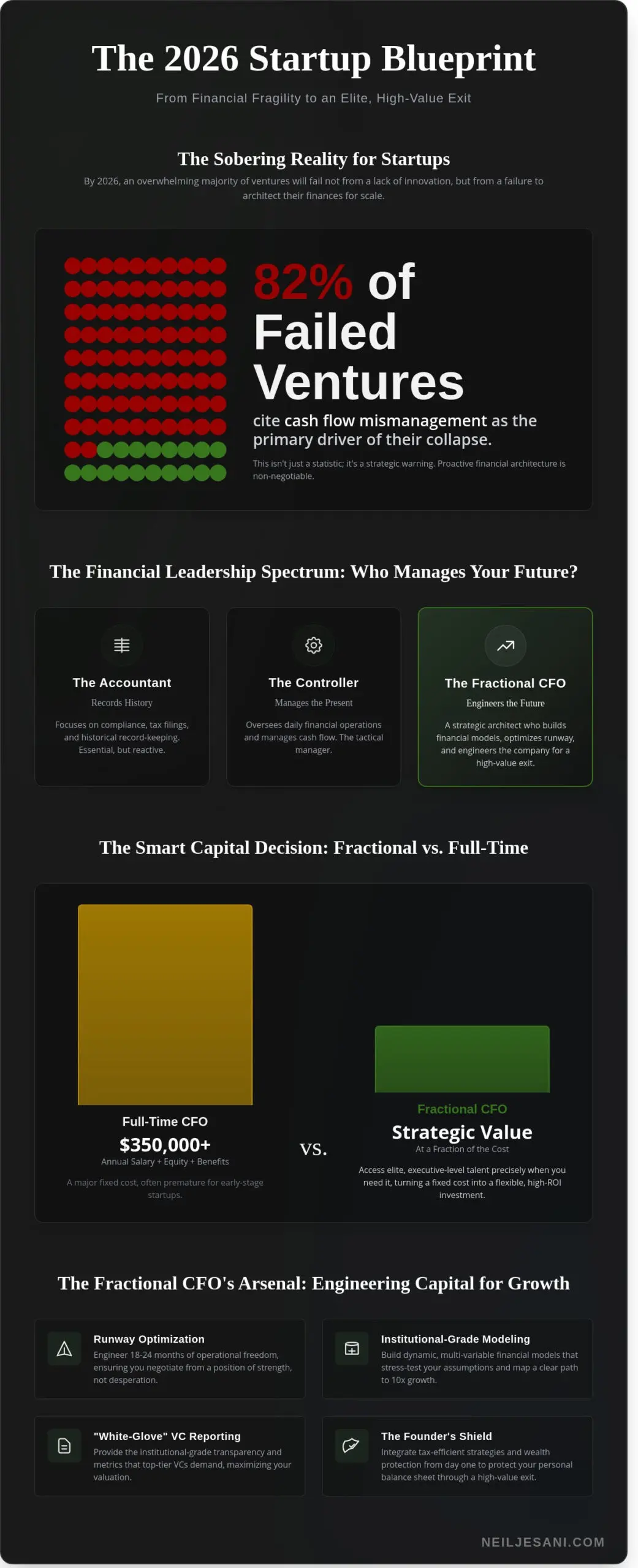
Is your startup actually built to scale, or is it just a high-speed burn rate disguised as disruption? By the start of 2026, industry data suggests that 82% of failed ventures will cite cash flow mismanagement as the primary driver of their collapse. You’ve worked too hard to let a diminishing runway or a lack of sophisticated reporting stall your mission. Engaging a fractional CFO for startups isn’t just about balancing books; it’s about deploying a strategic architect to win the war for money and success.
You likely agree that your current financial systems feel reactive rather than proactive. You deserve a white-glove framework that handles the complexity of multi-entity structuring and VC-grade reporting. This article promises to show you how to transform financial fragility into an elite, investor-ready blueprint that secures both company scaling and personal wealth preservation. We’ll examine the specific mechanics of runway optimization, tax-efficient exit strategies, and the roadmap to a high-value liquidity event.
Key Takeaways
- Learn to distinguish between basic accounting compliance and the elite financial architecture required to navigate the 2026 venture capital landscape.
- Discover how a fractional cfo for startups engineers institutional-grade financial models that optimize cash flow and maximize valuation for your next funding round.
- Analyze the strategic framework that allows founders to access elite executive talent at a fraction of the cost of a $350k+ full-time hire.
- Master the “Founders Shield” to protect your personal balance sheet and engineer your business for a tax-efficient exit from day one.
- Follow a disciplined, two-step blueprint to audit your financial architecture and clean your cap table in preparation for a 2026 liquidity event.
The Strategic Architect: Defining the Fractional CFO for Startups in 2026
The 2026 venture capital landscape has shifted from a “growth at all costs” mentality to a “surgical precision” era. Founders can no longer afford to treat their finance department as a back-office utility. They need a tactician. To win the war for money and success, your leadership team must distinguish between historical record-keeping and forward-looking financial engineering. While an accountant records history and a controller manages the present, the Chief Financial Officer (CFO) engineers the future. This distinction is the difference between surviving a bridge round and scaling toward an elite exit.
A fractional cfo for startups acts as the strategic architect of your firm’s destiny. They don’t just report on the runway; they widen it through sophisticated capital allocation and risk mitigation. This proactive mandate is essential for 2026. Data from Q1 2026 indicates that 72% of failed startups cited “unforeseen cash flow bottlenecks” as their primary cause of death. A fractional partner anticipates these roadblocks 12 months in advance, ensuring your burn rate aligns with your long-term blueprint rather than just your monthly bills.
Beyond Filing: The Executive-Level Value Proposition
Standard accounting is about compliance; strategic financial leadership is about leverage. Moving from historical reporting to forward-looking financial engineering allows you to treat your balance sheet as a weapon for growth. An elite CFO doesn’t just hand you a P&L statement. They provide the narrative and the data-backed confidence required to dominate high-stakes board meetings. They translate complex multi-entity structures and R&D tax credits into clear, actionable strategies that protect your equity. Startups need a fractional cfo long before they think they’re ready. Waiting until your Series B to secure institutional-grade oversight is a recipe for dilution and structural fragility.
The 2026 Startup Ecosystem and Financial Fragility
The current market volatility has created a “funding gap” between Seed and Series B rounds, where 45% of companies struggle to secure follow-on capital without perfect unit economics. A fractional partner provides the institutional-grade stability that lean teams lack. They identify the “fragility points” in your current structure, such as high customer acquisition costs (CAC) or inefficient ISO distributions. By implementing a bespoke financial framework, they ensure your startup isn’t just growing, but is becoming “investor-ready” every single day. This white-glove approach transforms your finance function from a cost center into a growth catalyst, providing the peace of mind that your legacy is built on a foundation of mastery.
Engineering Capital: Core CFO Functions That Drive Startup Valuation
Runway management requires more than just spending less. It demands surgical cash flow optimization. We aim to secure at least 18 to 24 months of operational freedom by identifying waste in the burn rate and optimizing accounts receivable cycles. This ensures you never enter a negotiation from a position of desperation. Our “White-Glove” approach to investor relations means your data room is ready before the first pitch meeting even happens. We provide the institutional-grade transparency that Series A investors demand, focusing on the metrics that drive 5x or 10x multiples.
Fundraising as a Scientific Discipline
Top-tier VCs look for precision, not just potential. We transform your financial data into a rigorous data room that withstands the most aggressive due diligence. Managing the capital table is critical. We prevent the common 20% dilution errors that haunt founders during Series B and C rounds. By engineering an “Equity Narrative,” we frame your growth as a mathematical certainty rather than a hopeful projection. This discipline allows you to maintain control while attracting the elite capital necessary for dominance.
Operational FP&A for Aggressive Scaling
Scaling without a map is a recipe for a cash crunch. We implement cfo advisory services to ensure every dollar spent aligns with your overarching corporate blueprint. This involves more than just tracking expenses; it’s about optimizing unit economics at every level of the organization.
- Scenario Planning: We prepare for the best and worst-case market shifts, ensuring you have a “Plan B” that protects your 90% gross margin targets.
- Departmental Budgeting: We align marketing, sales, and R&D spend with the Rule of 40 to ensure growth remains efficient.
- KPI Architecture: We focus on the metrics that actually matter, such as maintaining a Net Revenue Retention (NRR) above 115% and an LTV/CAC ratio exceeding 3:1.
A fractional cfo for startups identifies the specific levers that increase your enterprise value. We help you win the war for money and success by treating your finance department as a strategic profit center rather than a back-office cost. This proactive stance ensures you are always prepared for the next stage of the journey.
Fractional vs. Full-Time CFO: A Cost-Benefit Framework for Founders
Founders often view executive hiring as a binary choice: either you pay for a full-time leader or you settle for basic bookkeeping. This perspective is a strategic error that drains capital and slows momentum. A top-tier tech CFO commands a base salary of $350,000 or more. When you add 1.0% equity, comprehensive benefits, and recruitment fees, the total investment often exceeds $500,000 annually. For a Seed or Series A company, this burn rate is often unsustainable. A fractional cfo for startups offers a different architecture; it provides institutional-grade strategy without the executive-level price tag.
The Economic Reality of Executive Hiring
The true cost of a full-time hire isn’t just the salary; it’s the dilution of your cap table and the time lost during a four-month search process. A fractional partner can be operational within 14 days, providing an immediate ROI. These professionals allow you to scale your financial sophistication alongside your funding rounds, ensuring you don’t over-hire too early. This is why fractional cfo services for small business are the bridge to your first major exit. You get the blueprint for success without the permanent overhead of a $30,000 monthly paycheck.
- Salary and Equity: Full-time hires demand 0.5% to 1.5% of your company; fractional partners require zero equity.
- Onboarding Speed: Executive searches take 120 or more days. Fractional onboarding takes less than two weeks.
- Scalability: Adjust your service level from 5 hours a week to 20 hours as your complexity increases.
The Elite Selection Criteria
How do you find a partner who acts as an advocate rather than a mere vendor? Look for a heritage of excellence. Our firm brings 200+ years of combined heritage in financial strategy to the table, ensuring your Strategic Architect understands the battlefield. The biggest objection founders have is whether a part-time partner can truly grasp their vision. The reality is that an elite fractional cfo for startups doesn’t need 40 hours a week to understand your goals; they need a proven framework to execute them.
They focus on high-impact wins. This includes optimizing R&D tax credits, managing AMT exposure for your team, and engineering a capital structure that impresses Series B investors. They align with your board to ensure every financial move supports the long-term legacy you’re building. You aren’t just buying hours; you’re accessing a sophisticated system designed to win the war for money and success.
The Founders Shield: Integrating Tax Strategy and Wealth Protection
Most traditional CFOs focus exclusively on the corporate ledger. They track burn rates and manage runways while ignoring the most critical asset in the room: the founder’s personal balance sheet. This oversight is a strategic failure. A high-performance fractional cfo for startups acts as a tactical advocate, bridging the gap between company milestones and personal prosperity. We don’t just file papers; we engineer the business for a tax-efficient exit from day one. This involves navigating the complexities of Section 1202 Qualified Small Business Stock (QSBS), which can potentially exclude up to $10 million or 10 times the basis in capital gains from federal taxes for those who qualify.
Engineering wealth requires a proactive mindset. If you wait until a Series B or a liquidity event to think about your personal exposure, you’ve already lost the war. We design forward-looking frameworks that go beyond simple compliance. We address the high-stakes pain points of tech leadership: high-income tax drag, AMT exposure on ISOs, and the risk of personal liability in a volatile market. Our mission is to ensure you win the war for money and success by treating your personal wealth with the same institutional rigor as your company’s capitalization table.
Bespoke Tax Engineering for High-Growth Entities
We utilize multi-entity structuring to minimize tax drag across both corporate and personal levels. This isn’t just about picking a Delaware C-Corp; it’s about building a blueprint for long-term preservation. We leverage tax planning strategies that evolve as you scale from Seed to Exit. For instance, we maximize R&D tax credits, which allow eligible startups to apply up to $500,000 against payroll taxes annually. We also manage the following to protect your equity:
- 83(b) Elections: Mitigating future tax liabilities on unvested shares.
- ISO Exercise Windows: Strategically timing exercises to manage Alternative Minimum Tax (AMT) impact.
- RSU Vesting: Designing sell-to-cover strategies that prevent cash flow crunches during vesting events.
Wealth Preservation in the “War for Success”
Startup life is a battlefield where 90% of ventures fail. You need a superior tactician to ensure your personal assets aren’t casualties of business risk. Integrating asset protection into your CFO strategy is non-negotiable for the modern founder. We design a legacy that survives the liquidity event by shielding your wealth from creditors and litigation. Our white-glove approach ensures that your personal financial architecture is robust, holistic, and elite. By partnering with a fractional cfo for startups who understands the intersection of corporate growth and personal defense, you secure your future before the first term sheet is even signed.
Don’t leave your personal legacy to chance. Secure your white-glove wealth strategy today.
Implementing the Blueprint: Your Path to a 2026 Liquidity Event
The road to a 2026 exit is paved with precision, not hope. To position your venture for a high-multiple acquisition or a successful IPO, you must treat your financial department as a strategic weapon. A fractional cfo for startups doesn’t just record history; they engineer the future through a four-step tactical deployment designed to maximize enterprise value.
- Step 1: The Holistic Financial Audit and Architecture Review. We tear down legacy systems that can’t scale and rebuild a framework capable of handling institutional capital. This ensures your data is clean, verifiable, and ready for the scrutiny of Tier-1 investors.
- Step 2: Cleaning the Cap Table and Optimizing the Tech Stack. Messy equity structures are deal-killers. We scrub your cap table to remove “dead equity” and integrate an automated tech stack that reduces manual accounting errors by up to 40%.
- Step 3: Establishing the Monthly Strategic Briefing Rhythm. We replace dry P&L reviews with high-stakes war room sessions. These briefings focus on forward-looking projections rather than just looking in the rearview mirror.
- Step 4: Executing the Growth Plan and Monitoring “North Star” Metrics. We obsess over the ratios that drive valuation, such as your Burn Multiple and LTV/CAC. If your Net Revenue Retention (NRR) isn’t hitting top-quartile benchmarks for a 2026 liquidity event, we pivot the strategy immediately.
What to Expect in the First 90 Days
The first quarter is about aggressive stabilization. You’ll see immediate runway wins through cost reduction. We typically identify 12% to 18% in redundant software spend or vendor inefficiencies within the first 30 days. We then transition your operations from “Chaos” to “Institutional-Grade.” This involves building a robust reporting framework for your board of directors that stands up to rigorous due diligence. By day 90, your financial data is no longer a liability; it’s a strategic asset.
Selecting Your Strategic Partner
Neil Jesani Advisors, Inc. intentionally limits its client base to fewer than 1,000 elite clients. We don’t provide a mass-market service; we offer a white-glove partnership for founders who demand excellence. You aren’t just hiring a consultant. You’re gaining an elite team that includes CPAs, tax attorneys, and wealth managers working in unison. This multi-disciplinary approach is essential to win the war for money and success. We don’t just “file taxes” or “do books.” We engineer bespoke strategies that protect your equity and your legacy. Taking the first step today ensures your startup is the one that exits while others simply fade away.
Engineer Your 2026 Liquidity Event Today
The road to a 2026 liquidity event isn’t built on standard accounting; it’s engineered through institutional-grade strategy. You’ve seen how the right fractional cfo for startups acts as a strategic architect, bridging the gap between operational scale and founder wealth protection. By integrating multi-entity structuring and tax optimization now, you ensure that your exit isn’t just a headline but a legacy-defining win.
Most founders settle for reactive compliance. We offer a proactive mission to win the war for money and success. Our elite team of 70+ CPAs, attorneys, and strategists brings 25+ years of mastery in wealth engineering to your corner. We purposefully limit our roster to fewer than 1000 clients to maintain a white-glove experience that goes beyond filing. It’s time to stop guessing about your valuation and start commanding it.
Schedule Your Elite Fractional CFO Strategy Session Today
Your vision deserves a blueprint that’s as ambitious as your growth targets. Let’s build it together.
Frequently Asked Questions
What is the typical cost of a fractional CFO for a startup in 2026?
A fractional CFO for a startup in 2026 typically costs between $4,500 and $12,500 per month depending on the complexity of your capital structure. This model saves you the $250,000 average base salary of a full-time executive while providing institutional-grade strategy. You pay for high-level architecture, not administrative overhead. It’s a surgical deployment of capital designed to protect your margins and engineer growth.
At what stage should a startup hire a fractional CFO?
You should hire a fractional CFO for startups when your company surpasses $1 million in annual recurring revenue or prepares for a priced equity round. Waiting until you’re too big is a tactical error that leads to messy cap tables and diluted equity. A strategic architect ensures your financial foundation is ready for 10x scaling. We help you win the war for money and success by building the framework before the pressure of a Series A hits.
How many hours a week does a fractional CFO typically work?
A fractional CFO typically works between 5 and 10 hours per week for an early to mid-stage startup. This isn’t about punching a clock; it’s about high-impact strategic interventions. We focus on board reporting, cash runway modeling, and unit economic optimization. You get the elite expertise of a seasoned veteran without the dead weight of a full-time executive salary. It’s a lean, efficient approach to financial mastery.
Can a fractional CFO help with Series A or Series B fundraising?
A fractional CFO for startups is essential for navigating Series A and Series B fundraising by managing the entire due diligence process. We don’t just help; we lead the financial narrative, build the five-year pro forma models, and defend your valuation to venture capitalists. This proactive approach ensures you secure the best terms while minimizing equity give-up. We engineer the data room to be bulletproof for institutional investors.
What is the difference between a fractional CFO and an outsourced bookkeeper?
A bookkeeper records the past, while a fractional CFO architects the future. Bookkeepers focus on transactional accuracy and compliance; we focus on capital allocation, tax optimization, and exit strategy. It’s the difference between filing a report and engineering a legacy. Our beyond filing philosophy ensures your financial data serves as a weapon for growth rather than just a record for the IRS. We provide the strategy, they provide the data.
Does a fractional CFO manage the existing accounting team?
A fractional CFO serves as the strategic head of your finance department, providing direct oversight to your internal accountants or external vendors. We implement rigorous internal controls and establish high-performance KPIs for your team. This leadership ensures that every team member is aligned with your mission to protect wealth and optimize outcomes. We provide the elite guidance your current staff needs to excel in a high-growth environment.
How does a fractional CFO integrate with my personal tax planning?
We integrate your corporate strategy with personal wealth protection by optimizing for QSBS exemptions and managing RSU or ISO vestings. Your business and personal finances aren’t separate battlefields; they’re one ecosystem. We design bespoke frameworks to reduce your effective tax rate and secure your family’s legacy. This holistic approach ensures that your business success translates directly into personal financial freedom and long-term security.
What technical stack should a modern startup CFO implement?
A modern CFO implements an institutional-grade stack centered on ERPs like NetSuite or Sage Intacct, integrated with Brex for spend management and Rippling for payroll. We eliminate manual data entry and replace it with automated, real-time reporting. This architecture provides the transparency required by Tier 1 venture capital firms. We build a digital nervous system that scales with your ambition and provides instant visibility into your cash position.