

Your CPA is likely costing you millions by focusing on the rearview mirror instead of the windshield. While you’re busy scaling companies and managing complex RSU and ISO packages, a silent tax drag is likely eroding 40% to 50% of your annual earnings. You’ve realized that standard tax filing isn’t a strategy; it’s an autopsy of wealth already lost. It’s time to stop being a passive taxpayer and start acting as a strategic architect of your own capital.
You shouldn’t have to settle for reactive advice that ignores the nuances of multi-state income and multi-entity structuring. This article provides an institutional-grade blueprint on how to reduce taxable income for high earners by flipping the script on the tax system. We’ll move beyond simple deductions to explore bespoke tax architecture that significantly lowers your AGI and preserves wealth across generations. By the end of this briefing, you’ll understand the proactive frameworks required to win the war for money and success in 2026.
Key Takeaways
- Shift from reactive filing to proactive tax architecture to neutralize “tax drag” and protect your wealth from compounding erosion.
- Discover how to reduce taxable income for high earners by leveraging multi-entity structuring and S-Corp/C-Corp synergies to optimize diverse income streams.
- Move beyond standard retirement accounts with institutional-grade asset architecture designed to maximize portfolio efficiency through advanced tax-loss harvesting.
- Unlock the power of cost segregation and R&D tax credits to accelerate depreciation and capture significant deductions often missed by traditional CPAs.
- Build a holistic wealth defense framework that integrates tax and estate planning to ensure your legacy remains liquid and protected for the next generation.
The High-Earner Tax Trap: Why Standard Compliance Fails in 2026
The 2026 fiscal cliff isn’t a theory; it’s a scheduled event. On December 31, 2025, the sunset of the Tax Cuts and Jobs Act (TCJA) will trigger a violent shift in the tax landscape, reverting the top individual bracket to 39.6% and slashing the standard deduction by nearly half. For those earning at the highest levels, standard compliance is no longer a survival tactic. It’s a path to significant capital erosion. If you’re searching for how to reduce taxable income for high earners, you must recognize that the IRS won’t send a thank-you note for your overpayment; they expect it. Most elite professionals are currently caught in the “W-2 Trap,” a structural prison where they lack the obvious write-offs of business owners while facing the full brunt of “tax drag.”
Tax drag is the silent friction that destroys compounding wealth. It’s the 2% or 3% annual loss to taxes that, when projected over a 25-year career, costs a high-net-worth individual millions in lost opportunity. We don’t just file forms; we engineer outcomes. To win the war for money and success, you must transition from being a passive taxpayer to a proactive wealth architect who views tax efficiency as a core investment metric.
The Invisible Cost of Passive Tax Management
Passive tax management is the equivalent of leaving your vault door unlocked in a high-crime district. As your income grows, “tax-bracket creep” ensures that every raise or bonus delivers diminishing returns because the government takes a larger slice of every marginal dollar. This isn’t just an administrative hurdle; it’s a direct assault on your legacy. You need to shift your mindset from “filing” to “architecture.” Strategic Tax Planning is a forward-looking engineering discipline designed to optimize capital efficiency before the fiscal year ends.
Filing vs. Strategy: What Your Current CPA is Missing
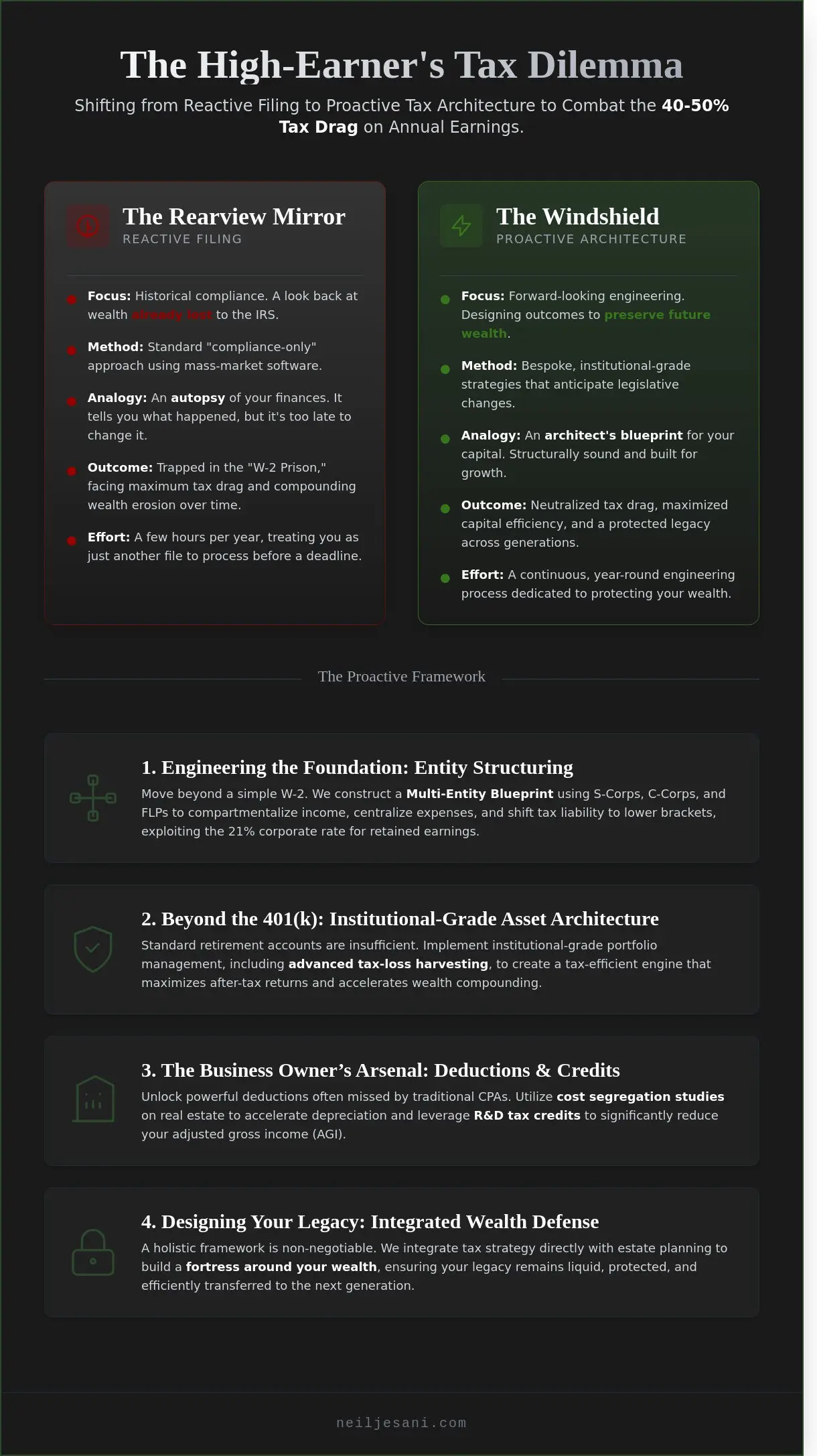
Most CPAs are historians. They look through the rearview mirror to report what you’ve already lost to the IRS. This “compliance-only” approach is effectively working for the government, not for you. Standard tax software is built for the masses, not for the sophisticated needs of tech executives or high-level surgeons. It fails to identify institutional-grade tax planning strategies that involve multi-entity layering or RSU optimization.
True strategy goes beyond the basics of understanding itemized deductions and standard credits. With the rise of the OBBBA and other legislative headwinds, the elite need a white-glove approach that anticipates changes rather than reacting to them. High earners often ask how to reduce taxable income for high earners while relying on a professional who only spends four hours a year on their file. That’s a recipe for mediocrity. Our boutique framework ensures that your wealth is protected by a continuous, bespoke engineering process that goes far beyond filing.
Engineering the Foundation: Income Shifting and Entity Structuring
High earners often find themselves trapped in a reactive cycle, paying nearly 50% of every marginal dollar to the government. You don’t have to accept this. To win the war for money and success, you must treat your tax return as a rigorous engineering project. Mastering how to reduce taxable income for high earners starts with moving beyond simple W-2 or K-1 reporting and into sophisticated entity architecture.
The Multi-Entity Blueprint
Sophisticated wealth isn’t held in a single bucket. We use management companies to centralize expenses and optimize deductions across separate business interests. By layering a C-Corp alongside an S-Corp, you can exploit the 21% corporate tax rate for retained earnings while maintaining pass-through benefits elsewhere. This strategy integrates advanced tax planning for high net worth individuals into your core corporate structure. Family Limited Partnerships (FLPs) further allow you to shift taxable events by transferring minority interests to family members in lower brackets. This isn’t just about moving numbers; it’s about shifting the tax liability to where it’s least impactful. By 2026, the expiration of certain TCJA provisions will make this structural compartmentalization even more critical for wealth preservation.
State-Level Arbitrage and Residency Planning
If you’re living in California or New York, you’re fighting a two-front war. State domicile audits are becoming more aggressive as high-tax jurisdictions face budget shortfalls. Shifting your domicile to Florida or Nevada requires more than just a new driver’s license. It requires a “clean break” strategy to survive a residency audit. For those who can’t move, we utilize Incomplete Gift Non-Grantor Trusts (INGs) to shield passive investment income from state-level taxes. This type of advanced tax planning allows you to reside in a high-tax state while your assets grow in a tax-neutral environment. We also look at the mechanics of shifting income to lower-bracket family members through legitimate employment, which can shield up to $14,600 per person from federal tax using the standard deduction.
The “Reasonable Compensation” hurdle remains a primary focus for the IRS. If you’re a business owner, you can’t simply take all profits as distributions to avoid self-employment tax. You must engineer a salary that satisfies the IRS while maximizing your QBI deductions. This balance is delicate. Most CPAs play it too safe, leaving hundreds of thousands on the table. We don’t guess; we use data-backed benchmarks to defend your position. If you’re ready to stop overpaying, it’s time to re-engineer your financial architecture with a proactive team.
Beyond the 401(k): Institutional-Grade Asset Architecture
Standard retirement accounts are the floor, not the ceiling. For a professional earning $1 million or more, a $23,000 401(k) contribution is a rounding error that fails to move the needle on a 37% marginal tax rate. True wealth protection requires a shift from retail savings to institutional-grade engineering. If you want to know how to reduce taxable income for high earners in 2026, you must look at the structural design of your entire portfolio. We don’t just fill out forms; we build frameworks that protect your capital from unnecessary erosion.
The Mega Backdoor Roth strategy remains a cornerstone for those with the right plan architecture. By utilizing after-tax contributions and in-plan conversions, you can shield up to $69,000 annually into a tax-free vehicle. For business owners and founders, Section 1202 (Qualified Small Business Stock) offers an even more aggressive advantage. This provision allows for a 100% exclusion of capital gains up to $10 million or 10 times your basis, provided the stock was held for five years. It’s a definitive strategy to exit a venture without handing a massive portion of your success to the IRS.
The Elite Investment Framework
Direct Indexing has replaced generic ETFs for the sophisticated investor. By owning the individual underlying securities, we can harvest specific losses to offset gains, often creating 1% to 2% in annual tax alpha. This level of high net worth tax planning separates the elite from the average. We also evaluate Opportunity Zones (OZs) with extreme caution for the 2026 cycle. Since the deferred tax on OZ investments is due on December 31, 2026, your liquidity must be engineered now to avoid a surprise cash crunch. Institutional strategies focus on the exit, not just the entry.
Charitable Architecture: CRTs and DAFs
Charity isn’t just about giving; it’s about strategic timing and legacy. Charitable Remainder Trusts (CRTs) allow you to sell highly appreciated assets, such as tech stocks with a low cost basis, without immediate capital gains hits. You receive an immediate deduction and a lifetime income stream. When combined with a Donor Advised Fund (DAF) during a high-income spike year, you effectively “win the war for money and success” by converting tax liabilities into a philanthropic powerhouse. This is how you how to reduce taxable income for high earners while building a name that lasts. It’s about going beyond filing and starting to engineer a future that’s entirely under your control.
The Business Owner’s Arsenal: Strategic Deductions and Credits
Stop playing defense with your P&L. If you’re a business owner, your tax return shouldn’t be a history report. It should be a strategic blueprint. By 2026, the gap between standard filing and elite tax engineering has widened. You need to weaponize every available provision to win the war for money and success. Understanding how to reduce taxable income for high earners requires moving beyond simple deductions into institutional-grade incentives.
R&D credits aren’t reserved for lab coats. If you’re developing proprietary software, improving manufacturing processes, or engineering new technical solutions, you qualify. Captive insurance allows you to turn risk management into a tax-advantaged wealth vehicle. You’re essentially self-insuring while building a low-correlation asset that accumulates value over time. Meanwhile, the Augusta Rule (Section 280A) lets you rent your home to your corporation for 14 days annually. This creates tax-free income for you and a legitimate business deduction for the company.
Accelerating Depreciation and Expense Capture
Real estate remains the ultimate tax shield for those who know how to use it. A cost segregation study identifies assets within a building that depreciate over 5, 7, or 15 years instead of the standard 39. This creates massive paper losses to offset active income. While bonus depreciation is scheduled to sit at 20% for 2026, the window still allows for significant Section 179 expensing. This provision lets you deduct up to $1.16 million for qualifying equipment purchases. Use this tax saving strategies for high income earners checklist to ensure your year-end execution is flawless.
Advanced Credits and Incentives
The 2026 landscape requires mastery of Section 174 capitalization rules. You can’t simply expense R&D costs anymore. You must amortize them over 5 years for domestic research. This shift makes state-specific credits, like those found in Georgia’s film industry or Pennsylvania’s tax assistance programs, even more critical for cash flow. When you’re ready to exit, we don’t just look for a buyer. We structure the deal for maximum efficiency. Using an Employee Stock Ownership Plan (ESOP) or an installment sale can defer or eliminate capital gains. This is how you protect your legacy and discover how to reduce taxable income for high earners through multi-entity structuring.
Ready to move beyond basic compliance and start engineering your wealth?
Designing Your Legacy: Integrating Tax Strategy with Wealth Defense
High-net-worth success isn’t just about what you make; it’s about what you keep across generations. Most advisors treat tax planning and estate planning as separate silos. This fragmented approach creates massive wealth leakage that costs families millions. By 2026, when current tax provisions are scheduled to sunset, the gap between those who have a blueprint and those who merely “file” will widen into a canyon. We view these disciplines as a single, holistic framework designed to win the war for money and success.
Mastering how to reduce taxable income for high earners requires a tactical shift from defense to offense. You don’t need a historian to tell you what happened last year; you need a Strategic Architect to engineer what happens next. True wealth defense integrates your legal structure with your tax strategy to ensure your capital remains under your control, rather than becoming a voluntary contribution to the federal government.
Fortifying the Wealth Fortress
Effective asset protection creates a secondary layer of tax efficiency by moving assets into structures that are less vulnerable to both litigation and unnecessary taxation. When your financial, legal, and tax advice is uncoordinated, you’re essentially fighting a war with a divided command. Our white-glove approach eliminates this friction. We oversee the 200+ years of combined heritage at your service to ensure every move is synchronized.
We often utilize Irrevocable Life Insurance Trusts (ILITs) to provide immediate liquidity for estate taxes. This is critical because federal estate tax rates can hit 40% for estates exceeding current exemptions. Without an engineered liquidity plan, your heirs might be forced to liquidate high-performing assets at a 30% discount just to satisfy the IRS. By integrating ILITs into your broader strategy, you ensure the tax bill is covered by pennies on the dollar, preserving the core of your legacy.
The Next Step: From Theory to Execution
The ultimate answer to how to reduce taxable income for high earners isn’t found in a generic checklist. It’s found in a bespoke tax strategy session with Neil Jesani Advisors. We don’t accept everyone who walks through the door. To maintain our elite level of service, we limit our client base to fewer than 1000 families. This exclusivity ensures that your “Strategic Architect” is always available to pivot your strategy as laws change.
You’ve spent your life building an empire. Don’t let a lack of coordination dismantle it. Our “Architect” model moves you beyond the limitations of traditional wealth management into a realm of institutional-grade precision. Stop filing and start engineering your financial future today. Schedule your consultation and secure the heritage you’ve worked so hard to build.
Master Your Financial Architecture for 2026 and Beyond
Standard tax filing is a rearview mirror approach that fails high-net-worth individuals in the shifting 2026 landscape. You’ve seen how multi-entity structuring and institutional-grade asset architecture serve as the foundation for wealth defense. By shifting income and leveraging strategic business deductions, you move from passive compliance to active wealth engineering. Understanding how to reduce taxable income for high earners isn’t about finding a single loophole; it’s about a holistic blueprint designed by experts who treat your wealth like a high-stakes mission.
Neil Jesani limits his practice to fewer than 1000 exclusive clients to ensure every strategy receives white-glove attention. Our in-house team of CPAs, Tax Attorneys, and Enrolled Agents brings over 200 years of combined institutional heritage to your table. We don’t just file; we win the war for your money and success. It’s time to stop overpaying and start building your legacy with absolute precision. You’ve worked hard to build your empire, and you deserve a strategist who fights to keep it intact.
Schedule Your Bespoke Wealth Architecture Session with Neil Jesani
Frequently Asked Questions
What is the most effective way for W-2 high earners to reduce taxable income?
High-income W-2 earners must pivot from passive compliance to active engineering by utilizing non-qualified deferred compensation plans and maximizing health savings accounts. These vehicles allow you to shield six-figure sums from the 37 percent top marginal bracket. When you understand how to reduce taxable income for high earners, you stop viewing your salary as a fixed liability and start treating it as a flexible asset to be optimized through institutional-grade strategies.
Can business owners still use the Augusta Rule in 2026?
Section 280A of the Internal Revenue Code, commonly known as the Augusta Rule, remains a potent tool in 2026 for shifting income from your corporation to your personal ledger tax-free. You can rent your primary residence to your business for up to 14 days annually at market rates, potentially generating 25,000 dollars or more in deductible business expenses. This strategy requires rigorous documentation and a professional valuation to withstand IRS scrutiny during the 2026 audit cycle.
How does a Charitable Remainder Trust (CRT) help reduce capital gains tax?
A Charitable Remainder Trust allows you to bypass the 20 percent federal capital gains tax on highly appreciated assets like tech stocks or real estate. By transferring these assets into a bespoke CRT, you receive an immediate income tax deduction based on 10 percent of the initial value. This institutional-grade framework protects your principal, generates a lifetime income stream, and ensures you win the war for money and success by preserving 100 percent of the asset’s growth.
Is a Mega Backdoor Roth still legal under current 2026 tax laws?
The Mega Backdoor Roth remains a legal and highly effective strategy in 2026 for those with employer-sponsored 401k plans that permit after-tax contributions. You can funnel up to 69,000 dollars into a tax-free growth environment, depending on your total contribution limits and employer match. This isn’t just a retirement hack; it’s a critical pillar of a holistic tax blueprint designed to eliminate future tax drag on your seven-figure portfolio and build lasting wealth.
What is the difference between tax evasion and strategic tax architecture?
Tax evasion is the illegal non-payment of taxes through fraud, while strategic tax architecture is the proactive application of the 75,000-page tax code to minimize liability legally. We don’t hide income; we engineer structures like family limited partnerships and captive insurance to optimize your position. Elite planning moves beyond filing historical data and focuses on forward-looking frameworks that respect the letter of the law while maximizing your financial sovereignty and peace of mind.
How much can a high-net-worth individual expect to save with advanced planning?
Individuals earning over 1 million dollars annually typically see a 30 percent to 45 percent reduction in their effective tax rate through advanced planning. By integrating tax-loss harvesting, QSBS exemptions, and multi-entity structuring, we’ve seen clients reclaim 250,000 dollars in a single tax year. These aren’t marginal gains. This is a deliberate offensive strategy to protect your wealth from the 2026 sunsetting of key tax provisions and rising state-level levies.
What should I look for when hiring a high-net-worth tax advisor?
You must seek a fiduciary advisor who specializes in “beyond filing” strategies rather than a traditional CPA who only looks in the rearview mirror. Look for a firm that manages fewer than 1,000 clients and offers a white-glove experience with a focus on RSU optimization and AMT exposure. Your advisor should be a strategic architect who understands how to reduce taxable income for high earners through complex, institutional-grade solutions tailored to your unique legacy.
How does the sunsetting of the TCJA affect my 2026 tax strategy?
The expiration of the Tax Cuts and Jobs Act on December 31, 2025, means the top individual rate reverts to 39.6 percent in 2026. You’ll also face a 50 percent reduction in the lifetime estate tax exemption, which forces a shift toward more aggressive gifting and trust strategies. We are currently redesigning blueprints to account for these shifts, ensuring our clients aren’t caught off guard by the 2026 return to pre-2017 tax brackets and limited deductions.