

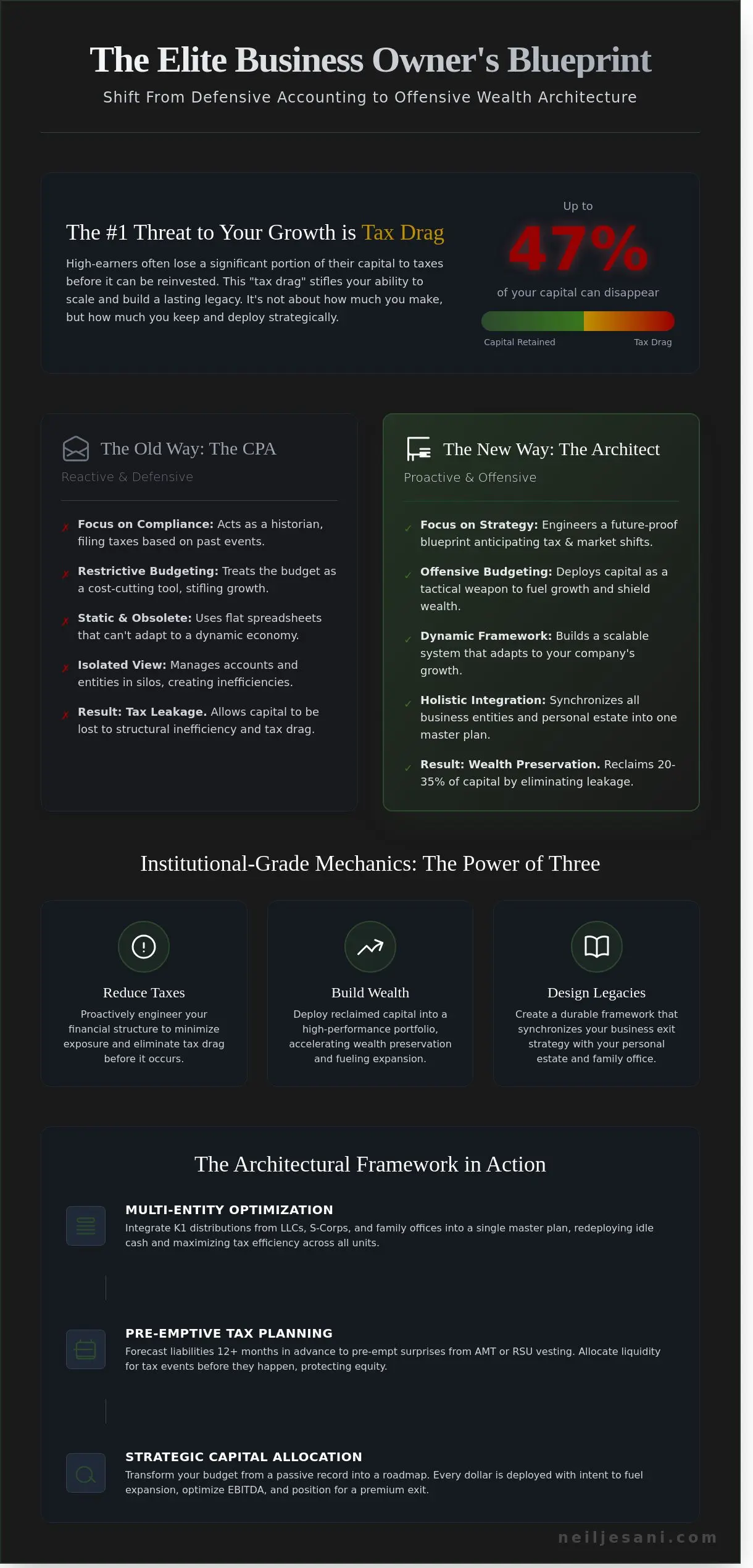
If you are still treating your annual tax filing as the primary measure of your financial success, you have already lost the war for your money. It is a common trap for high-earners; you have built a high-revenue engine, yet you feel increasingly squeezed by a tax system that penalizes your growth. When up to 47% of your capital disappears into tax drag, your ability to scale is stifled. You deserve a sophisticated approach to budgetary planning that goes beyond simple bookkeeping and enters the realm of institutional-grade architecture.
You recognize that traditional wealth management is built for the past, and you’re ready for a proactive blueprint that secures your future. We will show you how to master the elite frameworks used by top-tier business owners to minimize tax exposure and accelerate wealth preservation. This article provides a deep dive into multi-entity structuring, strategic capital allocation, and the precise steps required to engineer a lucrative business exit by 2026. It’s time to flip the script on the tax system and claim your position as the strategic architect of your own legacy.
Key Takeaways
- Transition from defensive household budgeting to an offensive architectural blueprint designed for high-stakes wealth preservation and elite asset protection.
- Master the mechanics of institutional-grade frameworks that integrate multi-entity structuring and K1 distributions into a single, high-performance master plan.
- Eliminate “tax leakage” by deploying a sophisticated budgetary planning process that prioritizes your future exit strategy and estate legacy.
- Understand why static budgets are obsolete in the 2026 economy and how to maintain a dynamic framework that scales alongside a fast-growing company.
- Learn to optimize EBITDA through strategic financial engineering, positioning your business for a premium valuation and a successful “war for money.”
What is Budgetary Planning for the Elite Business Owner?
For the ultra-high-net-worth individual, budgetary planning isn’t a restrictive exercise in cost-cutting. It’s a proactive architectural blueprint designed to maximize the velocity of your capital. While the general public might ask What is a budget? to manage household expenses, the elite business owner treats it as an offensive weapon. You aren’t just tracking where money went; you’re deploying tactical assets into a high-performance portfolio. Every dollar that leaves your firm must serve a specific strategic purpose, whether it’s fueling 15% year-over-year expansion or shielding wealth from the erosive effects of inflation.
The biggest threat to your growth isn’t usually a lack of revenue. It’s “tax drag.” When you operate without a rigorous framework, you often lose 37% or more of your top-line earnings to federal obligations before you even begin to reinvest. Budgetary planning identifies these leakage points with surgical precision. It transforms your financial statement from a passive record into a roadmap for winning the war for money and success. By treating your budget as a tactical asset, you stop playing defense and start engineering your financial victory.
The Shift from Compliance to Strategy
Traditional CPAs are historians. They focus on compliance and filing forms based on what happened last year. As a strategic architect, I focus on the future. With the Tax Cuts and Jobs Act provisions set to sunset on December 31, 2025, wealth preservation requires a shift from reactive accounting to forward-looking strategy. We move beyond the flat spreadsheet. We build a holistic framework that anticipates tax shifts and protects your legacy against legislative volatility. This is the difference between simply filing and truly building.
Budgetary Planning vs. Financial Forecasting
Precision matters in high-stakes wealth management. A forecast is a statement of probability based on historical market trends. A plan is a statement of intent. In volatile markets where the S&P 500 can swing 2% in a single afternoon, you need white-glove precision. We use budgetary planning to stabilize your operations by defining exactly how capital will be allocated. This ensures that even when the probability of a forecast shifts, your strategic intent remains unshakable and your liquidity remains intact.
Institutional-Grade Mechanics: Engineering Your Framework
Most high-earners treat their finances like a collection of accounts; we treat them like a fortress. True budgetary planning requires more than tracking expenses. It demands an architectural blueprint that synchronizes your business entities with your personal estate. We focus on the Power of Three: reduce taxes, build wealth, and design legacies. This isn’t a passive exercise. It’s an active mission to reclaim 20% to 35% of capital typically lost to structural inefficiency. We engineer strategies that ensure every dollar has a specific mandate. You aren’t just saving money. You’re deploying a tactical reserve designed for long-term growth.
Multi-Entity Optimization
Complex portfolios often involve multiple LLCs, S-Corps, or family offices. Each entity generates K1 distributions that must be integrated into a master plan rather than viewed in isolation. Effective budgetary planning identifies “hidden” capital by analyzing inter-company transfers and expense allocations. Instead of letting cash sit idle in a low-yield business account, we redeploy it into low-correlation alpha assets. Understanding how to prepare an organizational budget is the first step in managing these moving parts. We move beyond simple bookkeeping to engineer a flow of capital that maximizes tax efficiency across every unit you own. This holistic approach ensures that your business growth fuels your personal legacy without unnecessary friction.
Managing AMT Exposure and RSU Vesting
Are you a tech executive watching 40% or more of your RSU value vanish to taxes? You can’t wait until April to react to a vesting event. Strategic budgetary planning pre-empts Alternative Minimum Tax (AMT) surprises by forecasting tax liabilities 12 months in advance. We allocate liquidity for tax events before they happen, ensuring you aren’t forced to liquidate assets during a market downturn. If you’re managing ISOs or large vesting schedules, you need a tactician who understands the timing of these triggers. We’ve helped clients protect over $200,000 in equity value by simply adjusting their liquidity schedule to cover AMT liabilities. It’s about winning the war for your money before the first shot is fired. If you’re ready to stop reacting and start leading, explore our bespoke wealth strategies today.
Why Static Budgets Fail in the 2026 Economy
Most executives treat an annual budget like a stone monument. By March 2026, that monument is usually rubble. If you’re still relying on a “set-and-forget” model, you’re not planning; you’re guessing. High-growth companies often claim that budgetary planning is too restrictive. They’re wrong. A rigid budget is a cage, but a dynamic one is a GPS. In a 2026 landscape defined by 3.8% core inflation and shifting tax codes, your capital must be fluid. You need a superior tactician to pivot resources when the market shifts, not a clerk who follows a spreadsheet from 2025. We don’t just track spending; we engineer capital for maximum velocity.
The Trap of Historical-Based Budgeting
Looking at last year’s numbers to predict 2026 is a recipe for stagnation. If you simply add 5% to your 2025 line items, you’re ignoring the reality of a 5.5% Fed funds rate. This creates “budgetary slack,” where capital sits idle instead of being engineered for growth. We advocate for zero-based budgetary planning. Every dollar must justify its existence today, not because it existed yesterday. This institutional-grade approach mirrors the Treasury’s strategic planning and performance framework, ensuring every allocation aligns with current fiscal reality rather than past habits. We eliminate waste to fund your next acquisition or scale your tax-advantaged portfolio.
Scenario Planning for High-Net-Worth Individuals
For the elite earner, a budget isn’t about cutting expenses; it’s about defending a legacy. We build “what-if” models that account for a 15% market correction or a sudden shift in AMT exposure. This proactive framework serves as an early warning system. It identifies wealth erosion before it hits your balance sheet. You can maintain a white-glove lifestyle while scaling institutional-grade investments by pivoting capital the moment a signal changes. We don’t just file taxes. We architect the flow of money to ensure you win the war for success. Our strategy protects your lifestyle while aggressively funding the investments that build your 200-year legacy.
5 Steps to Building a Growth-Oriented Budgetary Plan
Strategic growth requires more than a simple spreadsheet; it demands a blueprint for financial warfare. Most high-earners lose 15% to 25% of their potential wealth to inefficient structures and passive management. To win, you must transition from reactive record-keeping to proactive budgetary planning. This five-step framework ensures your capital works as hard as you do.
- Audit Cash Flow: Identify “tax leakage” where missed deductions and poor entity structures drain your reserves.
- Set High-Level Targets: Align every dollar with your ultimate exit strategy, scaling goals, or estate legacy.
- Institutional Controls: Implement reporting milestones that mirror the rigor of a Fortune 500 company to prevent waste.
- Advanced Tax Integration: Deploy multi-entity layering and asset protection to shield your growth from external threats.
- Strategic Oversight: Utilize elite advisory to monitor variance and pivot in real-time as market conditions shift.
Auditing for Tax Leakage
Your current spend likely hides significant waste. The Strategic Architect method reviews the boundary between personal and business assets to spot structural flaws that standard CPAs miss. We’ve seen unoptimized capital cost business owners over $100,000 annually in unnecessary tax exposure. Calculating this real cost is the first step toward reclaiming your competitive edge. Stop settling for “standard” filings that ignore the nuances of your portfolio and start engineering your recovery.
The Role of the Fractional CFO
A bookkeeper records history, but a strategist engineers the future. High-income earners need a tactician to navigate complex RSU schedules, ISOs, and K1 distributions. By integrating fractional cfo services, you gain institutional-grade precision without the overhead of a full-time executive. This level of oversight turns budgetary planning into a high-yield activity. Precision in reporting allows for a 12% average increase in reinvestment capacity by identifying underperforming assets before they become liabilities.
Don’t let your wealth plateau due to administrative neglect. It’s time to engineer a superior financial future and secure your legacy today.
Beyond the Spreadsheet: Winning the War for Money
Budgetary planning is more than a defensive measure to control costs; it’s the offensive blueprint for your ultimate liquidity event. Most business owners treat their financials as a rearview mirror. We view them as the engine for a high-value exit. When you treat every dollar as a soldier in your private army, you stop merely surviving the fiscal year and start engineering a legacy that lasts generations.
Preparing for a Lucrative Exit
Your exit planning institute readiness depends entirely on the transparency and health of your numbers. For high-net-worth business owners, EBITDA (Earnings Before Interest, Taxes, Depreciation, and Amortization) serves as the primary driver of valuation, acting as the definitive scorecard for your company’s operational strength. A disciplined approach to budgetary planning optimizes this figure by stripping away inefficiencies and highlighting scalable profit centers.
Prospective buyers don’t just buy your current revenue; they buy your future stability. Cleaning up the balance sheet at least 24 months before a sale can prevent a 20% “risk discount” often applied by private equity firms. We focus on three critical areas to maximize your multiple:
- Eliminating non-essential discretionary expenses that cloud true profitability.
- Restructuring debt to improve debt-to-equity ratios.
- Aligning capital expenditures with long-term growth trajectories.
The Neil Jesani Advantage
We don’t operate like a high-volume retail firm. Our “fewer than 1000 clients” promise ensures that your wealth receives the white-glove, institutional-grade attention it deserves. You aren’t a line item in our system; you’re the commander of a sophisticated financial estate that requires elite tacticians. Our in-house team of CPAs and tax attorneys functions as your personal tactical unit, moving beyond simple compliance to architect forward-looking wealth strategies.
The traditional tax system is designed to capture the wealth of the uninformed. We flip the script. By integrating budgetary planning with advanced multi-entity structuring and low-correlation alpha strategies, we protect your hard-earned capital from unnecessary erosion. It’s time to stop settling for “standard” and start demanding excellence. Contact us for a bespoke strategy session to engineer your future and finally win the war for money and success.
Secure Your Financial Architecture for 2026
Static spreadsheets are relics of a slower era. To win the war for money in 2026, you need institutional-grade mechanics that adapt to real-time shifts. Effective budgetary planning isn’t about restriction; it’s about engineering a growth-oriented framework that protects your legacy while optimizing multi-entity structures. You’ve seen how a bespoke blueprint moves beyond simple compliance to proactive wealth preservation. It’s the difference between merely filing and strategically mastering your capital. Your vision requires more than a calculator; it demands a tactical map.
The complexity of modern wealth requires a superior tactician. For over 25 years, we’ve provided a white-glove experience that standard firms can’t match. Our team of 70+ specialized CPAs and tax attorneys doesn’t just manage numbers; we architect futures. We maintain exclusivity by serving fewer than 1000 elite clients, ensuring your strategy receives the precision it deserves. Don’t leave your 2026 outcomes to chance. Schedule Your Bespoke Tax Strategy Session today to flip the script on the tax system. Your wealth deserves a defense as aggressive as your growth.
Frequently Asked Questions
What is the primary difference between a budget and a budgetary plan?
A budget is a static snapshot of historical expenses; a budgetary plan is a dynamic architectural framework designed for future capital allocation. While a standard budget tracks where your money went last month, a plan engineers a 3 to 5 year growth trajectory. It aligns your immediate cash flow with high-stakes strategic milestones like business acquisitions or significant R&D investments.
How often should a high-net-worth individual review their budgetary plan?
High-net-worth individuals must execute a deep-dive review of their budgetary plan at least once every 90 days. Quarterly pivots allow you to account for shifting interest rates or 2 percent changes in market volatility. This consistent cadence ensures your wealth architecture remains resilient against legislative shifts or sudden liquidity events like a major RSU vest.
Can budgetary planning help reduce my 2026 tax liability?
Yes, proactive budgetary planning today allows you to engineer deductions before the Tax Cuts and Jobs Act (TCJA) provisions expire on December 31, 2025. By forecasting your 2026 income now, we can implement multi-entity structures or accelerated depreciation schedules. This strategy moves you beyond simple filing into a world of aggressive, institutional-grade tax optimization.
What is the role of a Fractional CFO in the planning process?
A Fractional CFO acts as the lead architect who translates your vision into a rigorous financial blueprint. They provide the elite oversight usually reserved for Fortune 500 firms without the 300,000 dollar annual salary of a full-time executive hire. This expert manages your capital stack, optimizes K1 distributions, and ensures every dollar serves your long-term legacy.
How does budgetary planning impact business valuation for an exit?
Robust budgetary planning can increase a business valuation by 20 to 30 percent during the due diligence phase. Sophisticated buyers pay a premium for clean financials and predictable 3 year growth forecasts. A disciplined plan proves to a private equity firm that your 5 million dollar EBITDA is sustainable and not a product of luck.
What are the most common mistakes high-earners make in their financial planning?
High-earners often fail by treating tax planning as an annual event rather than a continuous engineering process. They ignore the tax drag on their portfolios, which can erode 40 percent of wealth over two decades. Another mistake is over-investing in low-yield cash reserves instead of deploying capital into bespoke, low-correlation alpha opportunities.
Is budgetary planning necessary if I already have a full-time bookkeeper?
A bookkeeper records the past, but a budgetary plan secures your future. While your bookkeeper tracks where the last 50,000 dollars went, our strategic framework dictates where the next 5 million dollars should go. You don’t just need a historian; you need a superior tactician to win the war for money and success.
How do I start building an institutional-grade budget for my family office?
Start by consolidating all 10 or more of your entities into a single, transparent dashboard to eliminate visibility gaps. Map out your fixed costs, variable lifestyle expenses, and 10 year philanthropic goals. Finally, stress-test this model against a 25 percent market correction to ensure your family’s legacy remains protected regardless of sudden economic shifts.