

Your current wealth structure is likely a collection of historical accidents rather than a coordinated defense. A single predatory lawsuit in 2026 could dismantle decades of work, especially when 90% of the world’s litigation occurs right here in the United States. You’ve likely realized that standard asset protection strategies built for the previous decade aren’t enough to stop modern creditors or the 37% top federal tax bracket from eroding your hard-earned success.
It’s frustrating to watch your effective tax rate climb while the complexity of your multi-state entities creates more anxiety than security. We’ll show you how to architect a bespoke framework that integrates elite legal shielding with proactive tax optimization. This guide provides a strategic preview of the multi-layered, institutional-grade structures required to win the war for your money and ensure your legacy remains untouchable for generations to come. You’ll learn to transition from simple compliance to a proactive wealth architecture that offers genuine peace of mind.
Key Takeaways
- Learn why traditional umbrella insurance is no longer a sufficient primary defense and why your wealth requires a proactive architecture to survive the 2026 litigation landscape.
- Discover how to engineer multi-layered asset protection strategies that integrate entity structuring and statutory exemptions to isolate liability and secure your holdings.
- Analyze the technical advantages of Domestic Asset Protection Trusts (DAPTs) versus the “nuclear option” of offshore jurisdictions for high-stakes legacy preservation.
- Identify critical vulnerabilities in your current estate blueprint by auditing your exposure ahead of the high-impact 2017 tax provision sunset.
- Understand the “Strategic Architect” process used to transition from a standard financial plan to a bespoke, institutional-grade wealth fortress.
Why Your Wealth Needs an Architecture, Not Just a Plan
Most entrepreneurs treat their hard-earned wealth like a pile of cash sitting in an open field. They hope the fence is high enough, but they haven’t built a fortress. As we enter 2026, the litigation lottery has reached a fever pitch. Successful business owners are no longer just individuals; they’ve become high-value targets for predatory creditors. Relying on a standard 2 million dollar umbrella policy is like bringing a knife to a tank fight. It’s a surface-level fix for a structural problem. You need a proactive shield that functions as a sophisticated architecture, not just a reactive plan scribbled on a legal pad.
True security requires moving toward institutional-grade engineering that treats your net worth as a complex, interconnected system. Effective asset protection strategies aren’t just about hiding money or avoiding responsibility. They’re about creating legal barriers that make you an unattractive target before a single legal paper is served. You can find a comprehensive guide to asset protection to understand the basic legal foundations, but the elite level of wealth management requires a bespoke architecture. This architecture must withstand the three horsemen of wealth erosion: Lawsuits, Divorce, and the IRS. If your current strategy doesn’t address all three simultaneously, your gate is wide open.
The Litigious Reality for High Earners
The legal environment in 2026 is more aggressive than ever. Data from recent judicial reports indicates that over 15 million civil lawsuits are filed in the United States annually. If your net worth exceeds 5 million dollars, statistics suggest you have a 25 percent chance of being named in a lawsuit this year. Success creates a target. Predatory creditors look for deep pockets to settle quickly, regardless of the merit of the claim. This constant threat creates a massive psychological tax. Real peace of mind only comes when your assets are structured so that a personal judgment cannot touch your corporate holdings or family legacy. We move beyond simple filing to create a white-glove defense that protects your lifestyle and your future.
Asset Protection vs. Tax Strategy: The False Dichotomy
Many advisors treat legal protection and tax optimization as separate silos. This is a fatal mistake that leads to systemic tax drag. Protecting your assets while losing 40 percent of your growth to inefficient tax structures is a hollow victory. We view these disciplines as two sides of the same coin. By utilizing multi-entity structuring, we don’t just shield your capital from external threats; we also optimize for the 2026 tax landscape. This is the core of the Neil Jesani Advisors, Inc. philosophy. We don’t just file papers; we engineer a framework to win the war for money and success. Integration ensures that every dollar saved from a creditor is also working efficiently against the tax man. Our approach is designed for those who demand more than compliance. We provide the strategy required to thrive in a hostile financial world.
- Proactive Shielding: We stop threats before they materialize through rigorous legal engineering.
- Institutional-Grade Engineering: Our structures mirror those used by the world’s most successful family offices.
- Integrated Success: We combine asset protection strategies with aggressive tax optimization to maximize net retention.
The Wealth Fortress: Layers of Modern Asset Protection
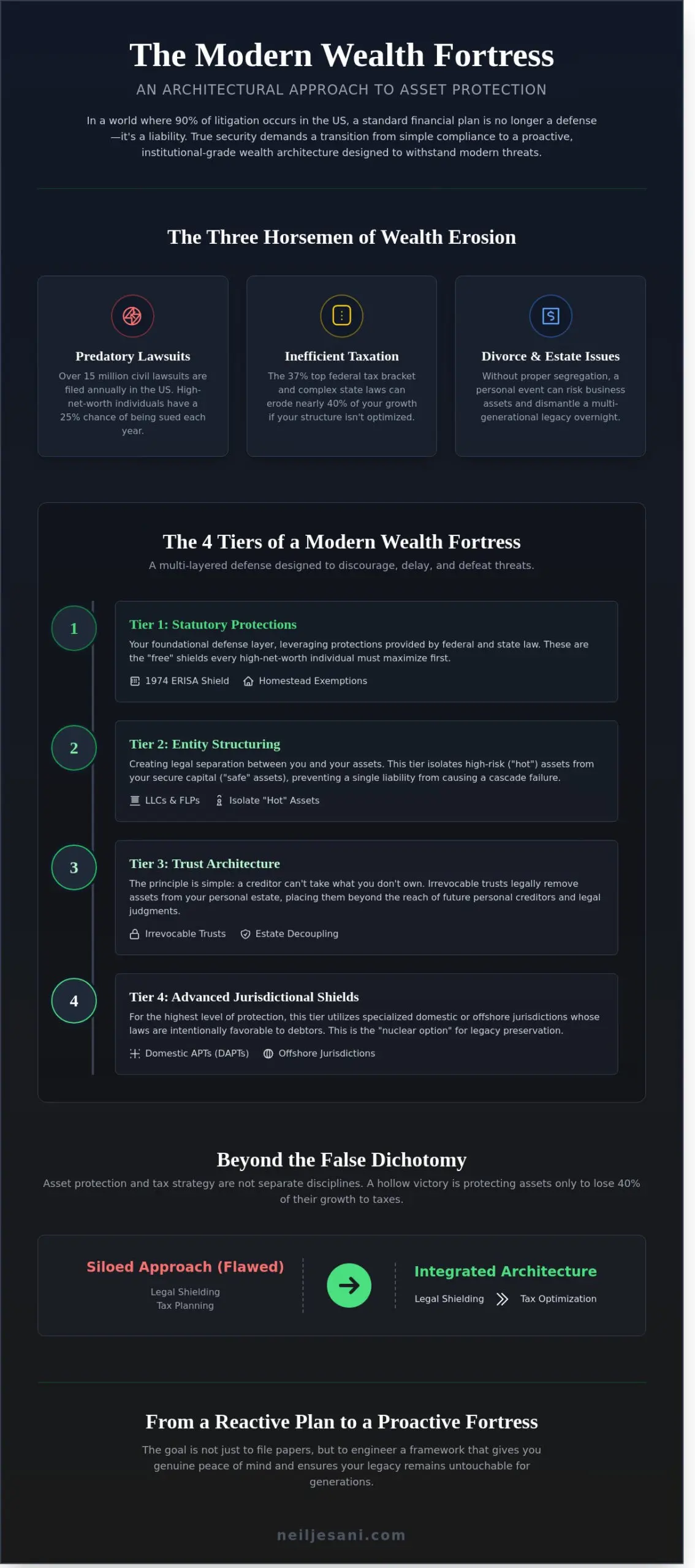
Most entrepreneurs treat their wealth like a glass house. They focus on the aesthetic growth while ignoring the stones thrown by a litigious society. A robust defense isn’t a single document; it’s a four-tier fortress designed to discourage, delay, and defeat threats before they reach your core capital. High-net-worth individuals don’t rely on luck. They engineer safety through a multi-layered blueprint that utilizes specific legal safe harbors and sophisticated entity design.
- Level 1: Statutory Protections. This involves maximizing the 1974 ERISA federal shield for retirement plans and state-specific homestead exemptions. These are your “free” legal defenses provided by the government.
- Level 2: Entity Structuring. We use LLCs and Family Limited Partnerships (FLPs) to isolate “hot” assets, like real estate or equipment, from “safe” assets like cash and securities.
- Level 3: Trust Architecture. Implementing Irrevocable Trusts removes assets from your personal estate. If you don’t own it, a creditor can’t take it.
- Level 4: Jurisdictional Arbitrage. This leverages the laws of debtor-friendly states. For example, Nevada Revised Statutes Chapter 166 provides a two-year statute of limitations on fraudulent transfer claims, which is significantly shorter than the four-year standard in 40 other states.
Building this fortress requires a proactive stance. Waiting for a process server to knock on your door is a recipe for total loss. You must move assets into these structures while the “seas are calm” to avoid claims of fraudulent conveyance. Effective asset protection strategies are about creating a legal distance between you and your property without sacrificing your lifestyle or investment control.
The Foundation: Homestead and ERISA Protections
Your primary residence is often your most vulnerable high-value asset. In Florida, Article X, Section 4 of the state constitution provides near-unlimited homestead protection regardless of the home’s value. Contrast this with other states where the exemption might only cover the first $50,000 of equity. Titling matters here. If you title a home incorrectly, you invite a “piercing of the veil” during a deposition. Simultaneously, we look to the 1974 ERISA act. This federal law provides an institutional-grade “super-shield” over qualified plans like 401(k)s, making them untouchable by most civil creditors. If you are managing high-value RSUs or complex ISO schedules, you need a bespoke wealth blueprint that integrates these statutory safe harbors into your broader financial plan.
The Outer Wall: Multi-Entity Structuring
Relying on a single LLC is a beginner’s mistake. If a slip-and-fall occurs at one rental property, every asset inside that LLC is at risk. We solve this by using holding companies to separate operations from equity. The Family Limited Partnership (FLP) remains a cornerstone of this strategy. It allows you to maintain 1% general partner control while gifting 99% of the limited partnership interests to heirs or trusts. This effectively “valuation discounts” the assets for tax purposes while making the interest unattractive to creditors. Since a creditor can generally only obtain a “charging order” against an FLP, they can’t force a liquidation. They’re stuck with a tax bill on income they can’t actually touch. This is how you flip the script on the legal system and win the war for your money.
Advanced Trust Strategies: Domestic vs. Foreign Shields
Wealth isn’t just about accumulation; it’s about defense. With the Tax Cuts and Jobs Act (TCJA) sunset looming on December 31, 2025, your window to engineer sophisticated asset protection strategies is closing. You don’t just need a lawyer; you need a strategic architect to build a fortress around your balance sheet. Waiting until a process server is at your door is a terminal mistake. You must deploy these institutional-grade frameworks while the “legal skies” are clear.
The DAPT: Nevada and Florida Deep-Dives
Nevada remains the undisputed gold standard for domestic trusts in 2026. Under NRS 166, the state offers a two-year statute of repose, which is the shortest in the nation. This means once your assets have been in a Nevada Asset Protection Trust for 24 months, a creditor’s ability to challenge the transfer effectively evaporates. For Florida business owners, the strategy is bespoke. Florida doesn’t have a DAPT statute, but it offers the nation’s strongest homestead protections under Article X of the state constitution. We often pair Florida’s residency benefits with a Nevada trust structure to create a multi-state shield. This prevents the 10-year federal bankruptcy look-back period from dismantling your legacy. You can explore our Florida Asset Protection guide for a granular breakdown of these state-specific exemptions.
Offshore Trusts: Myths vs. Strategic Reality
The Offshore Asset Protection Trust (OAPT) is the “Nuclear Option” for high-stakes litigation. Forget the Hollywood myths of tax evasion; this is about jurisdictional friction. We utilize the Cook Islands or Nevis because they don’t recognize US court orders. If a creditor wants your capital, they must fly to a foreign jurisdiction, hire local counsel, and prove their case “beyond a reasonable doubt” under a strict one-year statute of limitations. You’ll maintain full tax transparency through FBAR and FATCA reporting via IRS Forms 3520 and 8938. For entrepreneurs with a net worth exceeding $10 million, the $20,000 to $50,000 setup cost is a minor premium for an impenetrable barrier. It’s not about hiding money; it’s about making it mathematically impossible for a creditor to collect.
To win the war for money and success, you must understand the synergy between tax planning and protection. The Spousal Lifetime Access Trust (SLAT) is our preferred tool for the 2026 transition. By transferring up to $13.61 million into a SLAT before the 2025 deadline, you lock in the current high gift tax exemptions. This move removes the assets from your taxable estate while allowing your spouse to remain a beneficiary. It’s a bespoke solution that provides liquidity and defense simultaneously.
The “Fraudulent Conveyance” trap is the single greatest threat to your plan. Under the Uniform Voidable Transactions Act (UVTA) adopted by 45 states, courts can unwind any transfer made with the “intent to hinder, delay, or defraud” a creditor. If you move money after a lawsuit is filed, you’re too late. Timing is your most valuable asset. We use a proactive approach to ensure every transfer is documented for legitimate estate planning purposes long before a threat emerges. Your asset protection strategies only work if they’re implemented during periods of “solvency,” making the next 18 months the most critical period for your financial architecture.
- Nevada DAPT: Best for 2-year statutory protection and no state income tax.
- Cook Islands OAPT: The ultimate deterrent for high-stakes litigation.
- SLAT: The premier choice for locking in 2025 tax exemptions.
- Solvency Analysis: Essential to avoid the fraudulent conveyance trap.
You’ve spent decades building your enterprise. Don’t let a single predatory lawsuit or a shifting tax code liquidate your life’s work. We provide the white-glove expertise required to navigate these complex global systems. It’s time to move beyond simple filing and start engineering a future that’s truly secure.
The 2026 Audit: Is Your Current Strategy Still Valid?
December 31, 2025, represents a hard deadline for the American entrepreneur. The sunset of the 2017 Tax Cuts and Jobs Act (TCJA) isn’t a minor adjustment; it’s a structural reset of the financial battlefield. If your current blueprint relies on the elevated gift and estate tax exemptions, you’re standing on a platform that’s scheduled for demolition. Most founders treat their financial planning as a “set it and forget it” task, but the shifting legal landscape demands a superior tactician who understands that yesterday’s defense is today’s vulnerability.
Many entrepreneurs ignore advanced asset protection strategies because they haven’t hit an arbitrary $20 million net worth. This is a fatal math error. When the lifetime exemption drops from the current $13.61 million to approximately $7 million in 2026, anyone with a $5 million portfolio becomes a target for the 40% estate tax. You don’t wait for the fire to buy an extinguisher. You engineer the architecture now while the law still favors the proactive. Your local CPA is likely excellent at looking in the rearview mirror for compliance, but they often miss the forward-looking “low-correlation alpha” that elite structuring provides.
Conducting a Comprehensive Exposure Audit
A true audit requires a three-step offensive to identify where your wealth is leaking. First, we inventory personal versus business assets to isolate “toxic” liabilities like commercial debt or personal guarantees that could trigger a total loss. Second, we hunt for gaps in executive insurance; data shows 68% of standard policies fail to cover specific “piercing the corporate veil” scenarios that target business owners. Finally, we calculate the “Tax Drag” on your unprotected brokerage accounts. Losing 37% of your annual gains to federal taxes is a leak that compounds into millions of lost legacy wealth over a decade. We don’t just file; we optimize.
The 2026 Tax Sunset Preparedness
The window to fund irrevocable trusts is closing fast. We use Grantor Retained Annuity Trusts (GRATs) to freeze asset values at today’s prices, moving all future appreciation to your heirs tax-free. This is especially vital for tech executives with high RSU and ISO concentrations. Even if you’re a high-income W-2 earner, your asset protection strategies must evolve beyond the basic 401(k). We deploy bespoke multi-entity structuring to capture institutional-grade advantages, ensuring your wealth isn’t just growing but is bulletproofed against the 2026 volatility. We’re here to flip the script on the tax system and ensure you keep what you’ve spent a lifetime building.
Stop playing defense with your legacy and start engineering a blueprint that wins. Secure your white-glove strategic audit today to win the war for money and success.
Designing Your Legacy: The Neil Jesani White-Glove Approach
Most financial firms treat you like a line item on a spreadsheet. They prioritize volume over value. At Neil Jesani, we’ve flipped the script by limiting our practice to fewer than 1,000 elite clients. This isn’t just about exclusivity; it’s about the bandwidth required for high-stakes engineering. When you’re managing a complex web of business interests and private investments, you can’t afford a generic approach. You need a “Strategic Architect” who views your wealth as a battlefield where every move counts toward winning the war for money and success.
Our process begins with a comprehensive blueprint of your entire financial ecosystem. We don’t stop at a simple review of your bank accounts. We analyze your corporate structures, your 2023 tax liabilities, and your long-term estate goals. This moves you from a state of passive reporting to institutional-grade execution. We integrate Fractional CFO services directly into your asset protection strategies because a shield is only effective if the person holding it is financially sound. By monitoring your K1s, RSU vesting schedules, and ISO exercises in real time, we ensure your wealth fortress remains impenetrable as your business scales.
Such a holistic approach ensures that the financial legacy you build can support all aspects of your life, including passions and creative pursuits. For an inspiring example of a diverse artistic career, click here.
Bespoke Engineering for High-Stakes Wealth
Our team of 70 plus specialists, including tax attorneys and CPAs, doesn’t work in silos. They collaborate on a single, holistic strategy for every client. We call this our “Beyond Filing” promise. Most CPAs spend their time looking in the rearview mirror to report what happened last year. We engineer what happens in the next ten years. We don’t just file forms; we architect futures. Our 25 years of heritage has taught us that the most effective defense is built long before the first shot is fired.
Consider a case from October 2022. We worked with a client who held a $20.4 million real estate portfolio. They were facing a catastrophic $4.2 million liability event due to a tenant dispute that threatened their personal holdings. By utilizing multi-entity structuring and specific equity stripping techniques, we had already insulated their core assets. The result was a settlement for less than 5% of the original claim. This wasn’t luck; it was the result of a meticulously engineered plan designed to withstand extreme pressure.
Managing such a portfolio, especially if it includes international luxury properties, requires this level of foresight. To get an idea of the types of global real estate investments high-net-worth individuals are making, you can learn more about Julius Property.
Your Next Tactical Move
Waiting to see is the most expensive strategy you can adopt. In the world of high-stakes wealth, delay is decay. The legal system doesn’t reward the cautious; it rewards the prepared. If you’re an ultra-high-income earner or a business owner, you’re already a target for predatory litigation and aggressive tax audits. You’ve spent years building your empire. Don’t let a single event dismantle it in months. It’s time to stop reacting to the system and start mastering it with asset protection strategies that actually work.
The first step is a high-level strategy session with our senior advisors. We’ll look at your current vulnerabilities and show you exactly how to shore them up. This isn’t a sales pitch; it’s a tactical briefing. You’ll walk away with a clearer understanding of your risks and a roadmap for your “wealth fortress.” Your legacy is too important to leave to chance or a standard CPA firm. Schedule Your Advanced Asset Protection Audit today and start engineering a future that’s truly secure.
Secure Your Wealth Architecture for 2026 and Beyond
Wealth isn’t static, and your defense shouldn’t be either. As 2026 approaches, the gap between simple tax filing and true wealth architecture becomes a canyon. You’ve seen why modern asset protection strategies require more than a standard LLC or a basic will. They demand a multi-layered fortress that integrates domestic shields with foreign trusts to neutralize litigation and predatory tax shifts. At Neil Jesani, we don’t just file forms; we engineer outcomes. Our boutique firm limits its focus to fewer than 1,000 elite clients to ensure every strategy receives the white-glove attention it deserves.
With 25 years of strategic experience and a dedicated in-house team of tax attorneys, CPAs, and Enrolled Agents, we’ve mastered the science of keeping what you’ve earned. Stop playing defense with outdated tools. It’s time to deploy a blueprint that secures your family’s future across generations. Secure your legacy with an institutional-grade Asset Protection Strategy session. You’ve built an empire through discipline and vision; now we’ll ensure it remains invincible.
Frequently Asked Questions
Is asset protection legal or is it just ‘hiding money’?
Asset protection is a 100 percent legal framework designed to shield your wealth from future, unforeseen creditors. It’s not about hiding money; it’s about shifting the legal title of assets before a claim arises. Fraudulent transfer laws, like the Uniform Voidable Transactions Act adopted by 45 states, prevent you from moving assets once a threat exists. We focus on proactive architecture that follows every IRS and state guideline to ensure your legacy remains intact.
What is the difference between umbrella insurance and an asset protection trust?
Umbrella insurance provides a specific dollar limit of coverage, often capped at 5 million or 10 million dollars, while an asset protection trust creates a permanent legal barrier. Insurance companies often look for policy exclusions to avoid payouts. A bespoke trust removes the asset from your personal balance sheet entirely. This ensures that even if a judgment exceeds your policy limits, your core holdings remain untouchable by outside litigants or predatory creditors.
Can I protect my assets after a lawsuit has already been filed against me?
You cannot legally shield assets once a lawsuit is filed or even reasonably anticipated. Doing so triggers the Uniform Voidable Transactions Act, which allows courts to reverse your transfers and potentially charge you with contempt. Effective asset protection strategies must be implemented during peacetime when your legal horizon is clear. We recommend establishing your blueprint at least 2 years before any potential volatility to ensure you meet all statutory seasoning requirements.
Which state has the best asset protection laws in 2026?
South Dakota leads the nation in 2026 due to its superior privacy statutes and its 0 percent state income tax on trust assets. Nevada remains a close second, offering a 2 year statute of limitations on seasoning assets against creditors. These jurisdictions provide the institutional-grade privacy that ultra-high-net-worth families require. We often utilize South Dakota’s dynasty trust provisions to protect wealth for multiple generations without the burden of state-level taxation or public disclosure.
How much does it cost to implement a comprehensive asset protection strategy?
A professional asset protection framework typically requires an initial investment ranging from 15,000 to 75,000 dollars for high-complexity structures. This covers the legal architecture, entity formation, and strategic alignment of your holdings. While a basic LLC might cost 1,500 dollars, elite entrepreneurs need multi-layered systems. Consider this a one-time insurance premium to safeguard a 10 million or 50 million dollar legacy from the high costs of predatory litigation and aggressive plaintiffs.
Can an asset protection trust also help me reduce my income or estate taxes?
Yes, a properly engineered trust can simultaneously shield assets and optimize your tax profile. By using a Beneficiary Defective Inheritor’s Trust, you can remove future appreciation from your taxable estate. This is critical as we face the 2026 sunset of the Tax Cuts and Jobs Act, which will likely slash the estate tax exemption to roughly 7 million dollars. This dual-purpose strategy ensures you aren’t just defending your capital; you’re actively compounding it.
What happens to my protected assets if I go through a divorce?
Assets placed in an irrevocable trust before a marriage are generally treated as separate property and remain outside the reach of a divorce settlement. If the trust is established during the marriage, the 50-50 community property rules in states like California or Texas may apply unless a prenuptial agreement is in place. We design divorce-neutral architectures that clarify ownership long before domestic disputes arise. This preserves your business’s integrity and prevents the forced liquidation of core assets.
Do I need an offshore trust if I live in the United States?
You don’t always need an offshore trust, but jurisdictions like the Cook Islands offer a level of protection that U.S. courts cannot breach. Domestic asset protection strategies are effective for 90 percent of claims; however, they remain subject to federal judge mandates. An offshore structure adds a layer of jurisdictional duress for creditors. It forces them to litigate in a foreign court where U.S. judgments aren’t recognized, which effectively ends most legal pursuits immediately.